How to Set Guitar Intonation at Home (Without an Expensive Strobe Tuner)
By David Aitken · The Complete Guitar · Dundee, Scotland
A player brought a Telecaster into my workshop last month with a familiar grievance: “David, I tune this guitar with my clip-on tuner until every string shows green. Open G and C sound gorgeous. But the moment I play an open D shape up at the 14th fret, or bar an F-sharp minor, it sounds sour. Is the neck warped?”
The neck was not warped. The frets were good.
I plucked the 12th-fret harmonic on the low E string. It rang nicely at 82.4 Hz. Then I pressed the string down at the 12th fret and struck the note. The strobe display spun to the right. The fretted note was sharp by 7.5 cents.
That 7.5-cent discrepancy is the difference between an instrument that sings in harmony and one that just doesn't sound right.
Intonation is the single most misunderstood mechanical adjustment on a guitar. Players treat it like black magic or assume it needs a £120 hardware strobe and years of apprenticeship.
The truth is, intonation is just adjusting a screw.
What Guitar Intonation Actually Means
Intonation determines whether every fretted note plays in tune across the full length of the fretboard.
On a purely theoretical guitar, the 12th fret sits at exactly half the scale length. With a 25.5-inch scale, that is 12.75 inches. Halve a vibrating string and its pitch doubles: an open E at 82.4 Hz becomes an octave E at 164.8 Hz.
Real guitars live in the physical world. Fretting a string at the 12th fret stretches it downward towards the fret wire. That deflection adds tension, and increased tension pulls the pitch sharp. Strings are also stiff: a thick wound low E resists bending near the saddle and nut, so its speaking length is shorter than its physical length.
To counteract this, builders offset bridge saddles backwards. This offset is called saddle compensation.
If the saddle sits too far forward, the speaking length is too short and the fretted note sounds sharp against the harmonic. Too far back, and it sounds flat. That directional rule governs all saddle calibration:
- Fretted note reads sharp: move the saddle back away from the nut (lengthen the string).
- Fretted note reads flat: move the saddle forward towards the nut (shorten the string).
Why Standard Clip-On Tuners Fail for Intonation
Before touching an intonation screw, understand why your everyday tuner is sabotaging your setup.
A typical clip-on vibration tuner or basic mobile tuning app has a resolution of roughly ±1 to ±2 cents. Many consumer apps deliberately add digital damping or “needle smoothing” to stop the display jittering. That helps a beginner tune open strings before rehearsal. For intonation work, needle damping is fatal.
A 2-cent error across the G and B strings causes noticeable beating in barred chords, yet a standard tuner shows solid green for both. You pack away your tools believing the guitar is dialled in, then wonder why your upper register still sounds off.
Professional luthiers rely on strobe tuners. A strobe compares incoming audio directly against an ultra-precise internal reference and does not smooth anything: if the note is out by even 0.02 cents, the pattern visibly spins. Historically that meant a dedicated bench unit like a Peterson Strobe for upwards of £120.
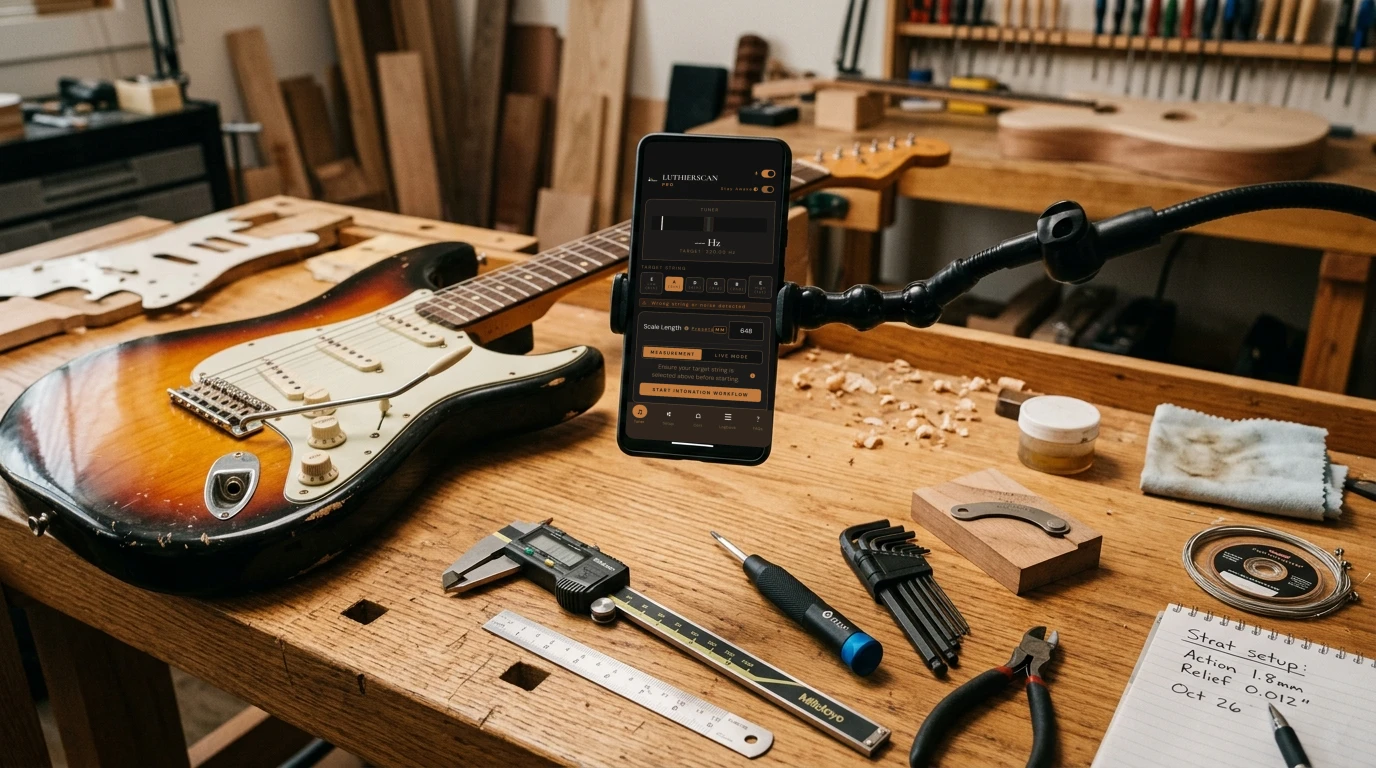
To solve this for players at home, I developed LuthierScan Pro (free on Google Play). Its custom C++ DSP engine calculates pitch with strobe precision down to ±0.01 cents, runs on any Android phone, and ignores background room noise.
LuthierScan Pro: Studio Strobe Precision on Your Phone
±0.01 cent hybrid C++ DSP tuning engine. Designed for home intonation and setup calibration without buying a £120 hardware unit.
Pre-Setup Checklist Before You Turn a Screw
Setting intonation out of order is the most common reason home setups go wrong. It is the final link in the physical chain, which at my bench follows the T.R.A.I.N. sequence:
- Tune: bring the instrument to concert pitch.
- Relief: adjust the truss rod for proper neck bow (typically 0.008 to 0.010 inches at the 8th fret).
- Action: set saddle heights for clean string clearance.
- Intonation: calibrate bridge saddle witness points.
- Noodling: play test and verify feel.
Excessive relief or high action makes the string travel further when fretted, pulling every note sharp. Adjust intonation on that guitar and you will run out of saddle screw travel before it plays in tune.
Confirm three prerequisites:
- Fit fresh strings: old, oxidised strings have irregular mass distribution and produce false overtones. Always intonate on fresh, pre-stretched strings.
- Set neck relief and action first: if you have not, read The Correct Guitar Setup Order before continuing.
- Lower magnetic pickups temporarily: pickups set too close drag wound strings out of true alignment (“wolf tones”). Back the height screws down two full turns while setting intonation.
Step-by-Step Intonation Adjustment
Step 1: Tune to Concert Pitch in Playing Position
Hold the guitar in your normal playing posture. Lying flat, gravity shifts neck relief by a fraction of a millimetre, which can introduce a 1 to 2 cent variance on wound strings.
Tune all six strings to concert pitch (A440) using LuthierScan Pro.
Step 2: Compare the 12th Fret Harmonic to the Fretted Note
Lightly touch the string directly above the 12th fret wire without pressing down. Pluck firmly and release your finger the instant you strike. When the strobe stands still, the harmonic is locked.
Now fret the note directly behind the 12th fret wire with normal playing pressure. A white-knuckle grip bends the string sharp and invalidates the reading. Pluck and watch the strobe:
- Rotates clockwise (right): fretted note is sharp. Move the saddle backward, away from the pickups.
- Rotates counter-clockwise (left): fretted note is flat. Move the saddle forward, towards the pickups.
- Motionless: this string is calibrated.
Step 3: Adjust the Saddle Screw
Slacken string tension slightly first. Turning a saddle screw under full tension strains the threads and can score the saddle contact surface. Use a screwdriver that fits the screw head snugly.
- On a Fender-style bridge, the screw sits at the back of the bridge plate.
- On a Gibson Tune-o-Matic, the screw faces either the tailpiece or the pickups depending on the bridge model.
Turn the adjustment screw to physically move the saddle in small, half-turn increments:
- If sharp: adjust the screw to move the saddle backward, away from the nut (lengthening the speaking length of the string).
- If flat: adjust the screw to move the saddle forward, towards the nut (shortening the speaking length of the string).
Step 4: Re-Tune and Re-Check
Bring the string back to exact concert pitch. Moving the saddle changes string length and tension, so never check intonation without re-tuning first.
Verify the 12th-fret harmonic is dead-on, then fret the 12th note. Repeat Steps 2 to 4 until the strobe is motionless for both, working across all six strings from low E to high E.
Common Intonation Mistakes to Avoid
I see the same four mistakes derail home intonation:
- Intonating with dead strings: if yours are older than three weeks of regular playing, change them before touching the bridge.
- Excessive fretting force: clamping down stretches the string into the fret trough. Use your normal clean-chord pressure.
- Leaving bridge pickups high: strong alnico magnets pull low strings sharp. Lower them first, then reset heights once intonation is locked.
- Skipping neck relief: intonation cannot compensate for a bowed neck. Check relief with a feeler gauge first.
Stubborn Frets or High Nut? When to Seek Workshop Calibration
Most electric and acoustic guitars can be intonated at home with patience, a well-fitted screwdriver and a strobe app. Some physical defects prevent clean intonation regardless of saddle position:
- Worn, flattened fret crowns: the contact point shifts to the front or rear edge of the wire, altering speaking length. Wide flat spots or deep ruts need levelling and recrowning.
- Incorrect nut slot heights: slots cut too shallow pull notes at the 1st to 3rd frets sharp even when the 12th fret is perfect. They need specialist nut files.
- Running out of saddle travel: if the screw reaches the end of its travel while the note is still sharp, the neck angle may need shimming or the bridge needs relocating.
If you are in Dundee, Angus or North Fife and your instrument resists home setup, book The Complete Setup (£95) or the Complete Fret Service (£115). Every service includes complimentary doorstep collection and return across Dundee, Broughty Ferry and Monifieth (Zone 1), with evening and weekend bench turnaround. I perform every setup myself to strobe tolerances.