Why Lemon Oil Ruins Pau Ferro Fretboards (And How to Darken Them Naturally)
By David Aitken · The Complete Guitar · Ballindean Road Workshop, Dundee
Players are buying new guitars every day and discovering that the fingerboards look pale, dry, and chalky — nothing like the rich, dark timber they picture in their minds. Straight out of the factory box or off the shop hanger, sliding up for whole-step blues bends feels scratchy, more like dragging calluses across unplaned pine than playing a finished musical instrument.
Naturally, players head online looking for quick fixes. Following typical forum threads, they douse the wood in mass-market “lemon oil” from a yellow plastic bottle until the frets glisten. When that doesn't darken the timber, things get desperate. I've seen forum chats and group threads where players genuinely talk about rubbing dark shoe polish or black leather dye into the fingerboard just to force it to look like vintage Brazilian rosewood.
Put the shoe polish away.
Pau Ferro and Indian Laurel are superb, resonance-rich tonewoods. But their cellular structure behaves nothing like traditional Indian rosewood. If you drown them in petroleum-based cleaners or artificial dyes, you create a greasy, destructive mess. Here is why modern alternative fingerboards arrive looking pale, why mineral lemon oil fails on their grain, and how I hydrate and darken them naturally on my Dundee workbench.
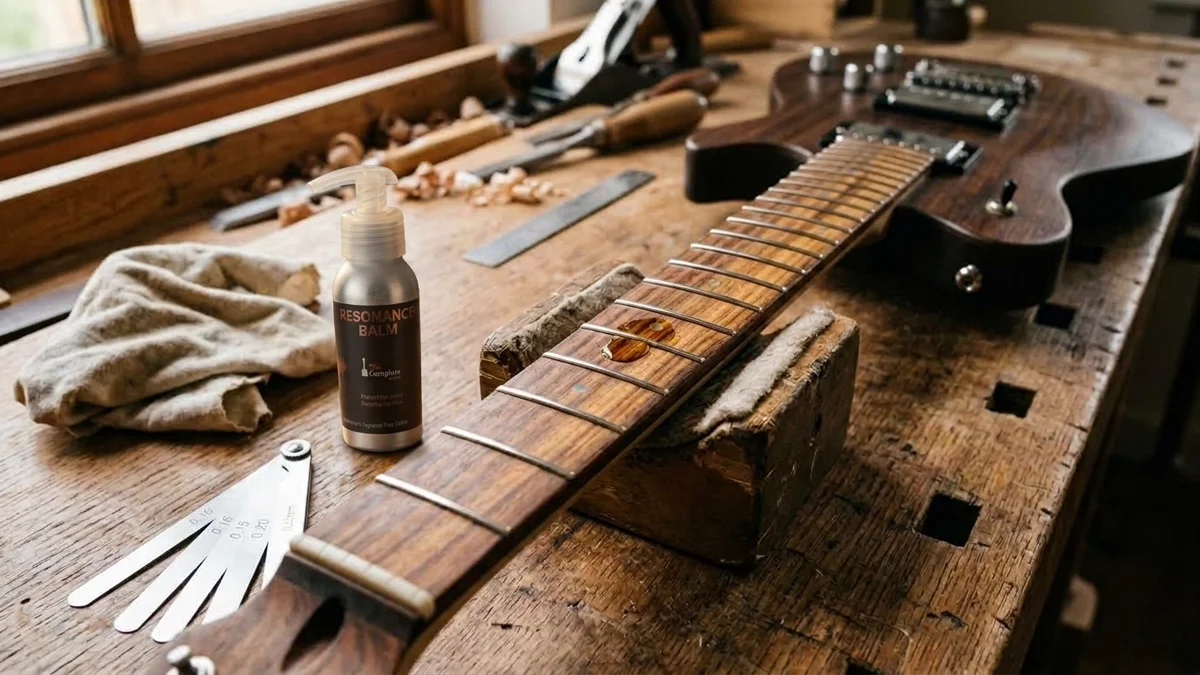
Why Modern Fretboards Look Pale
To care for modern guitar necks, you have to understand why guitar manufacturers changed timbers in the first place.
For over seventy years, dark Indian rosewood (Dalbergia latifolia) was the undisputed standard for electric and acoustic fingerboards. It was oily, naturally dark, and relatively forgiving. In 2017, international CITES regulations placed strict global trade controls on all Dalbergia species to prevent illegal logging.
Overnight, the largest guitar builders in the world had to find legal, sustainable hardwoods that could handle string friction and fret installation without warping.
                  THE MODERN FRETBOARD SPECIES SHIFT
┌─────────────────────────┐     CITES 2017     ┌─────────────────────────┐
│ Traditional Rosewood    │ ─────────────────► │ Modern Alternative      │
│ (Dalbergia latifolia)   │    Regulations     │ Hardwoods               │
└─────────────────────────┘                    └─────────────────────────┘
            │                                               │
            ▼                                               ▼
┌─────────────────────────┐                    ┌─────────────────────────┐
│ • Dark brown to violet  │                    │ • Pau Ferro (Morado)    │
│ • High natural resins   │                    │   Tight grain, silica   │
│ • Large open wood pores │                    │ • Indian Laurel         │
│ • Medium timber density │                    │   Dry open grain, pale  │
└─────────────────────────┘                    └─────────────────────────┘
Fender turned heavily to Pau Ferro (Machaerium scleroxylon, often marketed as morado or Bolivian rosewood) for their Mexican-built Player Series, Vintera models, and artist signatures. Epiphone, Squier, and Gretsch turned primarily to Indian Laurel (Cordia alliodora).
Neither wood is inferior. In fact, Pau Ferro is harder and denser than Indian rosewood, offering percussive attack and lightning-fast transient response that many guitarists prefer.
The catch is cosmetic and tactile. Straight from a dry factory storage container, both species often look gray, orange, or chalky. Guitarists expecting the rich, dark chocolate hue of a 1962 reissue open their guitar cases and feel immediately underwhelmed.
The Chemistry Dilemma: Why Mineral Lemon Oil Fails on Alternative Hardwoods
When players see a dry, pale fingerboard, their default reaction is to reach for traditional “lemon oil”.
This is where the trouble begins.
Commercial guitar lemon oil is not made from lemons. Real citrus oil is highly acidic and contains d-limonene, an aggressive chemical solvent that breaks down wood lignins and dissolves synthetic adhesives.
Instead, commercial lemon oil is almost entirely light mineral oil(liquid paraffin, a petroleum byproduct derived from crude oil refining) scented with 1% artificial lemon perfume and dyed bright yellow. Personally, I don't wish to expose myself to petrochemicals either.
               HOW PETROLEUM VS BOTANICAL CONDITIONERS BEHAVE
┌──────────────────────────────────────┐  ┌──────────────────────────────────────┐
│ COMMERCIAL MINERAL "LEMON OIL"       │  │ COLD-PRESSED BOTANICAL LIPIDS        │
├──────────────────────────────────────┤  ├──────────────────────────────────────┤
│ • 98% Refined Petroleum Distillate   │  │ • 100% Cold-Pressed Seed Oils        │
│ • Synthetic Alkane Molecules         │  │ • Triglycerides & Liquid Wax Esters  │
│ • Hydrophobic, Sits on Mineral Pores │  │ • Matches Natural Timber Chemistry   │
│ • Flashes Off in Days, Leaves Grease │  │ • Absorbs Deeply, Never Gums or Stays│
└──────────────────────────────────────┘  └──────────────────────────────────────┘
Petroleum mineral oils possess long, bulky synthetic alkane hydrocarbon chains. How these synthetic molecules react depends entirely on which alternative timber sits on your guitar:
1. The Pau Ferro Trap: Greasy Surface Pooling
Pau Ferro possesses exceptionally tight grain with microscopic cell pores and a very high natural silica content. The wood is physically dense.
Because petroleum mineral oil molecules are large and non-polar, they cannot penetrate the tight, mineralized pores of Pau Ferro. The liquid has nowhere to go. It pools on the surface, refuses to absorb, and creates a slippery, greasy layer that soils your fingers and deadens your guitar strings. For about a week, your neck feels like an oily frying pan.
2. The Indian Laurel Dilemma: Rapid Evaporation & Ashy Rebound
Indian Laurel behaves in the exact opposite manner. Laurel has an open, coarse fibrous structure with very low natural wax content.
When you apply mineral oil, the volatile carrier solvents evaporate almost immediately. Within forty-eight hours, the board dries out completely. Worse, the petroleum solvents strip out whatever trace natural oils the wood had retained, leaving the surface looking even grayer, rougher, and more chalky than before you touched it.
The Dangerous Myth: Dyes, Stains, and Leather Polish
Because mineral oil fails to darken Pau Ferro permanently, guitar forums are filled with terrible DIY shortcuts.
The most common bad advice involves wiping dark wood stains, walnut shoe polish, or Fiebing's leather dye across the fretboard.
Never put chemical dyes or shoe polishes on an assembled guitar neck.
                   THE DANGERS OF DIY CHEMICAL DYES
┌────────────────────┐     ┌─────────────────────┐     ┌────────────────────┐
│ Black Leather Dye  │ ──► │ Bleeds into Maple   │ ──► │ Irreversible Neck  │
│ or Shoe Polish     │     │ & Fret Slot Tangs   │     │ Cosmetic Damage    │
└────────────────────┘     └─────────────────────┘     └────────────────────┘
                                      │
                                      ▼
                           ┌─────────────────────┐
                           │ Discolours Plastic  │
                           │ & Celluloid Binding │
                           └─────────────────────┘
Here is what happens on the workbench when someone attempts this:
- Capillary Bleed into Fret Slots: Liquid dyes run under fret crowns through capillary action. If your neck has a maple sub-layer or unbound edges, the dye bleeds into the end grain, permanently staining the neck with unsightly black splotches.
- Binding Discolouration: If your fingerboard has white plastic, celluloid, or ABS binding, chemical dyes immediately soak into the porous edges of the binding. You cannot wipe it off. It requires scraping with a razor blade to remove.
- Porous Inlay Contamination: Real mother-of-pearl and synthetic pearloid dots absorb chemical dyes, turning your fret markers dirty gray.
- Black Fingertips: Stains sit on top of the dense Pau Ferro grain. As soon as your hands sweat during a gig, the dye re-liquefies and coats your fingertips.
You do not need chemical pigments to darken Pau Ferro or Indian Laurel. You simply need the correct botanical lipids.
The Luthier Solution: Pure Cold-Pressed Botanical Lipids
Wood does not want petroleum sludge. Wood is an organic biological matrix composed of cellulose, hemicellulose, and lignin.
To nourish dry tonewood, improve its surface feel, and reveal its deep natural dark tones, you must use cold-pressed plant lipids whose molecular structure matches the organic chemistry of hardwood fibers.
This is the exact reason I developed Resonance Balm (£9.99) in my Dundee workshop.
                      THE BOTANICAL HYDRATION MATRIX
┌──────────────────────┐  ┌──────────────────────┐  ┌──────────────────────┐
│ Jojoba Golden Lipid  │  │ Sweet Almond Oil     │  │ Pure Coconut Extract │
├──────────────────────┤  ├──────────────────────┤  ├──────────────────────┤
│ Liquid wax ester     │  │ Rich oleic acid chain│  │ Lightweight caprylic │
│ penetrates tight     │  │ softens dry timber   │  │ triglycerides lock   │
│ silicate grain       │  │ cell fibers          │  │ moisture in pores    │
└──────────────────────┘  └──────────────────────┘  └──────────────────────┘
Instead of crude mineral distillates and artificial lemon scents, authentic luthier conditioners rely on three complementary botanical lipids:
- Pure Virgin Jojoba Seed Liquid Wax: Chemically, jojoba is not an oil; it is a long-chain liquid wax ester that closely mimics natural wood resins. Because its molecular chain is exceptionally slender, it slips directly into the tight, mineralized pores of Pau Ferro without pooling.
- Cold-Pressed Sweet Almond Oil: Rich in unsaturated fatty acids, almond oil absorbs into the fibrous cell walls of Indian Laurel, rehydrating parched timber without creating surface tackiness.
- Fractionated Coconut Triglycerides: A stable, ultra-light carrier lipid that resists oxidation, rancidity, and gumming, leaving a completely dry, silky tactile finish under the frets.
When these botanical lipids penetrate dry Pau Ferro, they alter how light refracts through the translucent surface cells. The timber darkens naturally, shifting from dry cardboard orange to a deep, lustrous walnut brown with striking golden grain contrast. No dyes. No sticky residue. Just healthy, nourished tonewood.
Step-by-Step Workbench Tutorial: Conditioning and Darkening Alternative Fingerboards
Here is the exact protocol I follow on the workbench when conditioning dry Pau Ferro or Indian Laurel guitars:
                  BENCH CONDITIONING PROTOCOL AT A GLANCE
┌──────────────────┐     ┌──────────────────┐     ┌──────────────────┐
│ Step 1: Deep     │ ──► │ Step 2: Fret     │ ──► │ Step 3: Botanical│
│ Cleanse (Clarity)│     │ Polish & Buff    │     │ Hydration (Balm) │
└──────────────────┘     └──────────────────┘     └──────────────────┘
                                                           │
                                                           ▼
                                                  ┌──────────────────┐
                                                  │ Step 4: Curing & │
                                                  │ Buff-Off         │
                                                  └──────────────────┘
Required Workbench Tools & Materials
- •Surface Cleaner: Clarity Wash (£9.99) (pH-neutral, silicone-free surfactant)
- •Botanical Conditioner: Resonance Balm (£9.99)
- •Wiping Cloths: Two clean, lint-free cotton or microfibre cloths, or good-quality kitchen roll
- •Fret Polish: Ultra-fine 0000 steel wool (with pickups taped) or micro-mesh polishing pads (4000 to 12000 grit)
- •Precision Inspection Tools: 0.25mm feeler gauge and fret rocker
Step 1: Strip Old Sweat, Grime, and Mineral Sludge
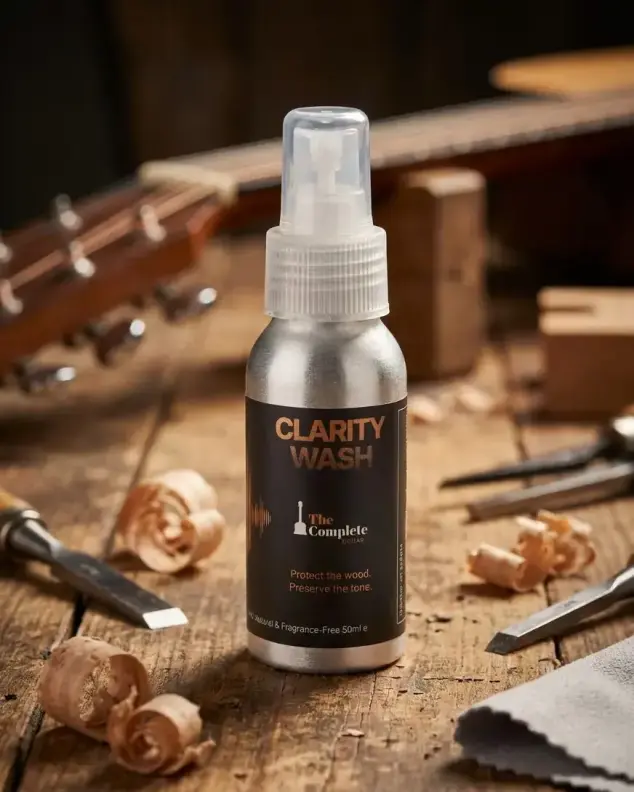
Never apply conditioner directly over dirt or old mineral oil. You will only seal sweat salts and grime into the wood grain.
- Remove the guitar strings completely.
- Inspect the fingerboard for grime build-up against the fret edges.
- Spray a small mist of Clarity Wash (£9.99) onto a clean cotton or microfibre cloth. Never spray liquid directly onto bare wood.
- Scrub each fretboard segment firmly along the grain from fret to fret. The aqueous surfactant lifts skin oils, dried sweat, and stubborn mineral residues without softening lacquers or neck glues.
- Buff the board completely dry with a clean section of cloth or kitchen roll.
Step 2: Buff and Crown the Fret Wire
With the timber clean and dry, take advantage of the bare board to inspect the frets.
- If using 0000 steel wool, place low-tack painter's tape securely over magnetic pickups to prevent metal shavings from shorting the coils. Alternatively, use micro-mesh polishing cloths which leave zero metal debris.
- Buff each nickel-silver or stainless steel fret wire across its crown until bright and mirror-smooth.
- Check the neck relief with a straightedge or feeler gauge at the 8th fret (nominal target: 0.25mm). A clean, smooth fret crown eliminates string friction on bends, making stiff alternative woods feel instantly effortless.
Step 3: Apply Botanical Lipids Along the Grain
THE DROPLET PENETRATION TEST
Place 1 tiny drop of Resonance Balm between the 7th and 8th frets and watch the perimeter:
- Thirsty wood: The timber pulls the amber liquid inward evenly within 60 seconds.
- Oversaturated: The droplet beads rigidly on the surface — wipe off excess immediately.
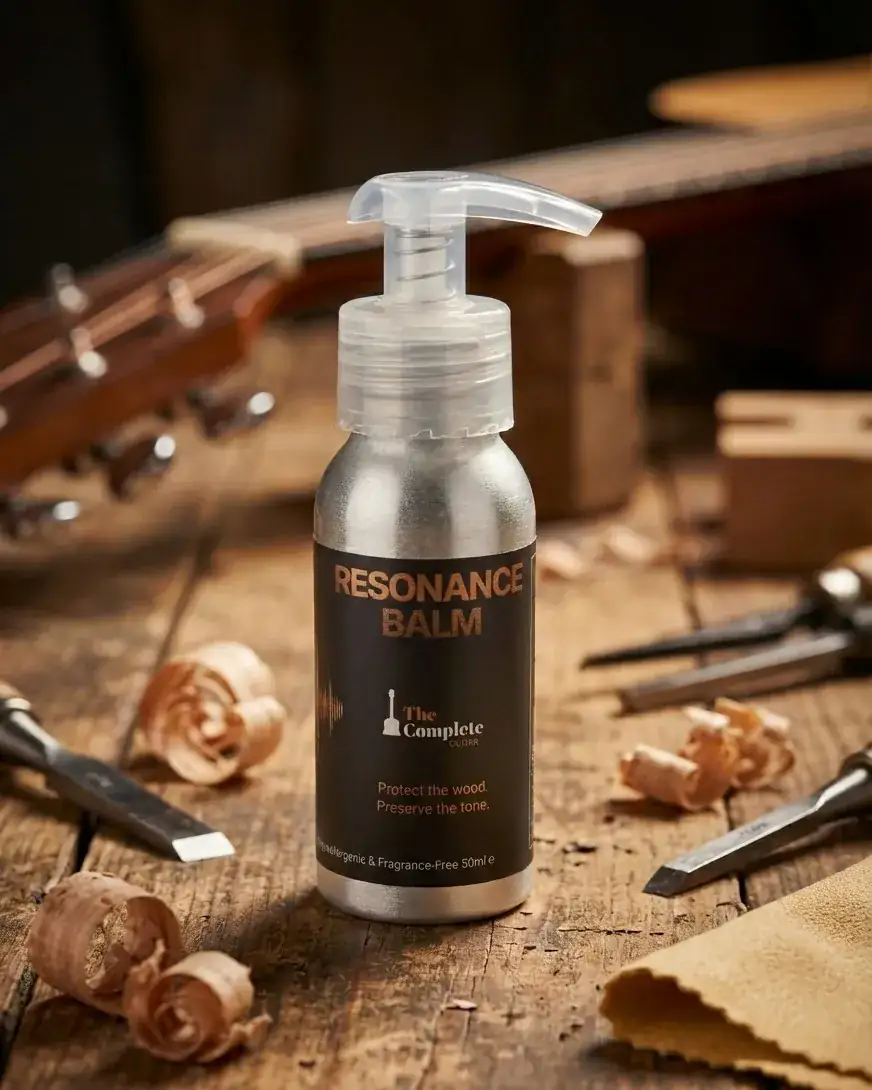
Dispense two to three small drops of Resonance Balm (£9.99) directly onto your cloth or directly onto the wood between frets.
- Using firm circular motions, work the balm into the pores right up against the fret wire where dry wood shrinkage is most pronounced.
- For dry Pau Ferro, a little goes a very long way. Two pea-sized drops are typically enough to treat an entire six-string fingerboard.
- Let the guitar rest on the bench for ten to fifteen minutes. Allow the jojoba and almond lipids to soak into the cellular structure of the timber.
Step 4: The 10-Minute Dry Buff-Off
This is the most critical step that many guitarists skip:
- Take a dry, clean cotton or microfibre cloth, or a good-quality piece of kitchen roll.
- Rub the fingerboard aggressively along the wood grain until the cloth or paper comes away completely dry.
- Check the corners of the frets. Make sure no excess oil has pooled against the fret tangs.
- When finished, your fingers should glide across the fingerboard without collecting a single speck of grease. The wood will display a rich, dark amber hue with enhanced grain definition, perfectly smooth under calluses.
Tonewood Comparison: Pau Ferro vs Indian Laurel vs Rosewood
To help you choose the right care routine, here is how the three common fingerboard woods compare on the workbench:
| Characteristic | Pau Ferro (Morado) | Indian Laurel | Indian Rosewood |
|---|---|---|---|
| Pore Structure | Exceptionally tight, dense, mineralized silica | Coarse, open, fibrous cell walls | Medium open pores, natural resins |
| Natural Surface Feel | Glassy, hard, percussive transient | Slightly chalky & dry straight from factory | Naturally oily, soft under fingertips |
| Untreated Colour | Tan, tawny orange, distinct stripes | Dull pale brown, grayish ash tone | Deep dark brown, chocolate, violet |
| Mineral Lemon Oil Reaction | Pools, smears, creates tacky grease film | Absorbs fast, flashes off in 48h (ashier) | Tolerates short-term, strips wood lignin |
| Best Botanical Care | Thin liquid wax esters (Jojoba) | Nourishing fatty acids (Sweet Almond) | Balanced botanical blend (Resonance Balm) |
| Frequency of Care | Once every 6 to 12 months (less is more) | Once every 4 to 6 months | Once every 6 to 12 months |
When to Seek Professional Workshop Care
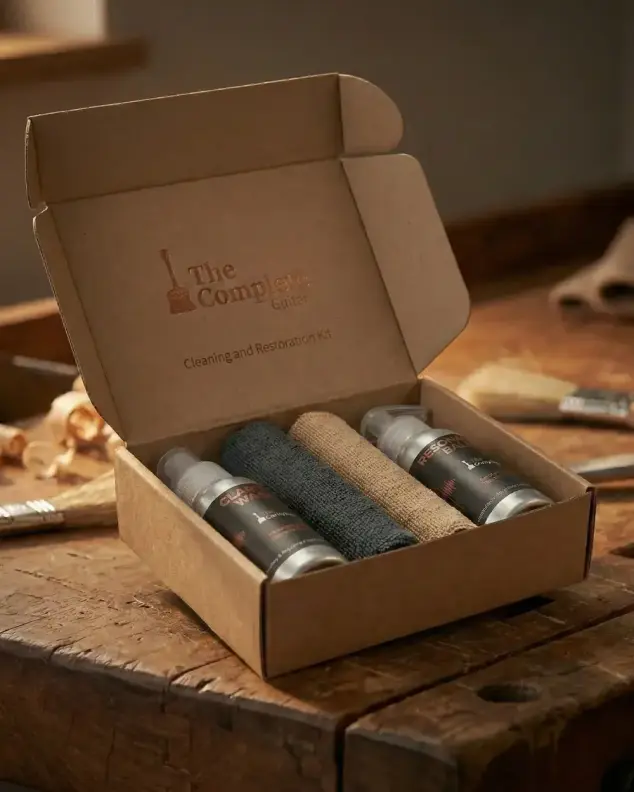
Hydrating your fingerboard with The Complete Guitar Care Kit Bundle (£18.99) is straightforward bench maintenance. However, if your guitar has been neglected in dry rooms for years, wood shrinkage may have caused physical structural issues:
                      DIAGNOSTIC TRIAGE CHECKLIST
┌──────────────────────────────────────┐  ┌──────────────────────────────────────┐
│ HOME CARE (Resonance Balm £9.99)     │  │ WORKSHOP BENCH CARE                  │
├──────────────────────────────────────┤  ├──────────────────────────────────────┤
│ • Pale, chalky surface colour        │  │ • Fret ends poking past wood edges   │
│ • Dry, scratchy feel under bends     │  │ • Choking notes above the 12th fret  │
│ • Light surface grime & sweat salts  │  │ • Uneven fret heights causing buzz   │
│ • Seasonal routine maintenance       │  │ • Seized bridge saddle height screws │
└──────────────────────────────────────┘  └──────────────────────────────────────┘
If your neck displays sharp metal edges catching your hand, you are dealing with seasonal fret sprout. Rehydrating the wood with botanical lipids can expand the timber back over the fret ends.
If severe fret sprout remains or if individual frets have lifted from their slots causing buzzing notes:
Dundee Workshop Core Service Tiers
Full workshop timber decontamination, ultrasonic hardware wash, botanical feed, and precision strobe tuning.
Truss rod calibration, saddle radius matching, nut slot depth profiling, intonation, and playability optimization.
Precision diamond levelling, crowning, bevel profiling, and hand-buffing to mirror finish.
3-Zone Local Catchment & Doorstep Booking
Zone 1 (Core Catchment — Free): Dundee (DD1–DD4), Broughty Ferry (DD5), and Monifieth (DD5 4) with 100% complimentary doorstep collection and return.
Zone 2 (Outer Catchment — £10 Fee): Carnoustie (DD7) and Longforgan (DD2 5).
Zone 3 (Regional — By Appointment): Drop-off and collection arranged strictly outside the workshop at 33E Ballindean Road, Dundee, DD4 8NN.
Pau Ferro & Tonewood Care FAQ
Luthier answers on alternative hardwoods, linseed oil, darkening myths, and finish safety.
Can I use boiled linseed oil on Pau Ferro?
Avoid boiled linseed oil. Most hardware store boiled linseed oils contain metallic chemical drying agents (cobalt or manganese driers) that polymerize into a hard, sticky plastic skin over dense woods like Pau Ferro. It turns sticky, traps grit, and requires harsh solvents to scrape off.
How often should I oil a Pau Ferro fretboard?
Less is more. Because Pau Ferro is naturally dense with tight mineral grain, it requires conditioning only once or twice a year. Applying conditioner every string change is unnecessary and leads to saturation around the fret tangs.
Will conditioning a fretboard make it permanently black?
No legitimate conditioner should permanently dye your wood black. Botanical oils darken timber by rehydrating the grain and altering surface light refraction, bringing out the wood's natural dark coffee and amber tones. If you want jet-black wood, buy an ebony fretboard. Never force artificial colour onto natural timber with shoe polish or chemical stains.
Why does commercial lemon oil fail on Pau Ferro and Indian Laurel?
Mass-market lemon oil is 98% petroleum mineral oil. Its bulky synthetic molecules cannot penetrate the dense silica pores of Pau Ferro, creating surface grease pools. On open-grain Indian Laurel, volatile petroleum solvents flash off within 48 hours, leaving the wood ashier than before.
Is Resonance Balm safe for satin and poly neck finishes?
Yes. Unlike crude petroleum solvents or real acidic citrus oils that soften nitrocellulose or cloud polyurethane, Resonance Balm (£9.99) contains 100% cold-pressed botanical lipids that are safe for all guitar finishes, plastic bindings, and shell inlays.
The Extractable Luthier Lesson
- Alternative Hardwoods Are Not Inferior: Pau Ferro and Indian Laurel are dense, sustainable alternative hardwoods with tight mineral pores and distinct cellular densities that yield rapid percussive attack.
- Why Mineral Lemon Oil Fails:Mass-market “lemon oil” is 98% refined petroleum mineral oil. It pools grease on dense Pau Ferro and evaporates in 48 hours on open-grain Laurel.
- Avoid Dyes & Shoe Polish: Never use leather dyes, walnut stains, or shoe polish to darken wood. They bleed into maple fret slots, ruin plastic bindings, and turn hands black.
- The Botanical Solution: Pure cold-pressed botanical lipids like jojoba liquid wax and sweet almond oil absorb deep into mineralized timber, restoring natural dark amber tones without sticky residue.
- Clean Before Conditioning: Always clean off old grime with a pH-neutral cleaner like Clarity Wash (£9.99) before applying Resonance Balm (£9.99), and always buff the surface completely dry.
Note: Some equipment links may be affiliate links that help support the workshop at no extra cost to you.
As an Amazon Associate, The Complete Guitar earns from qualifying purchases. We only recommend tools, accessories, and consumables verified on our Dundee artisan bench.
About the Maker & Workshop
Written and formulated by David Aitken. Every care formula and calibration protocol is developed through hands-on bench experience at The Complete Guitar workshop in Dundee, Scotland, dedicated to making every instrument play 1% better every day.
Dundee Artisan Workshop · Evening & Weekend Bench · Free Local Collection
Need Alternative Tonewoods Triaged or Serviced?
If your Pau Ferro or Laurel board is chalky, shrunk, or buzzing, our private Dundee bench provides complete decontamination, botanical lipid saturation, fret dressing, and full setup calibration with 100% complimentary doorstep collection across Dundee, Broughty Ferry, and Monifieth.
Dundee Workbench Calibration
Need hands-on bench calibration? Book The Complete Restring (£35), The Complete Clean & Hydrate (£65), The Complete Setup (£95), or The Complete Fret Service (£115) with complimentary doorstep collection and return across Dundee, Broughty Ferry, and Monifieth.