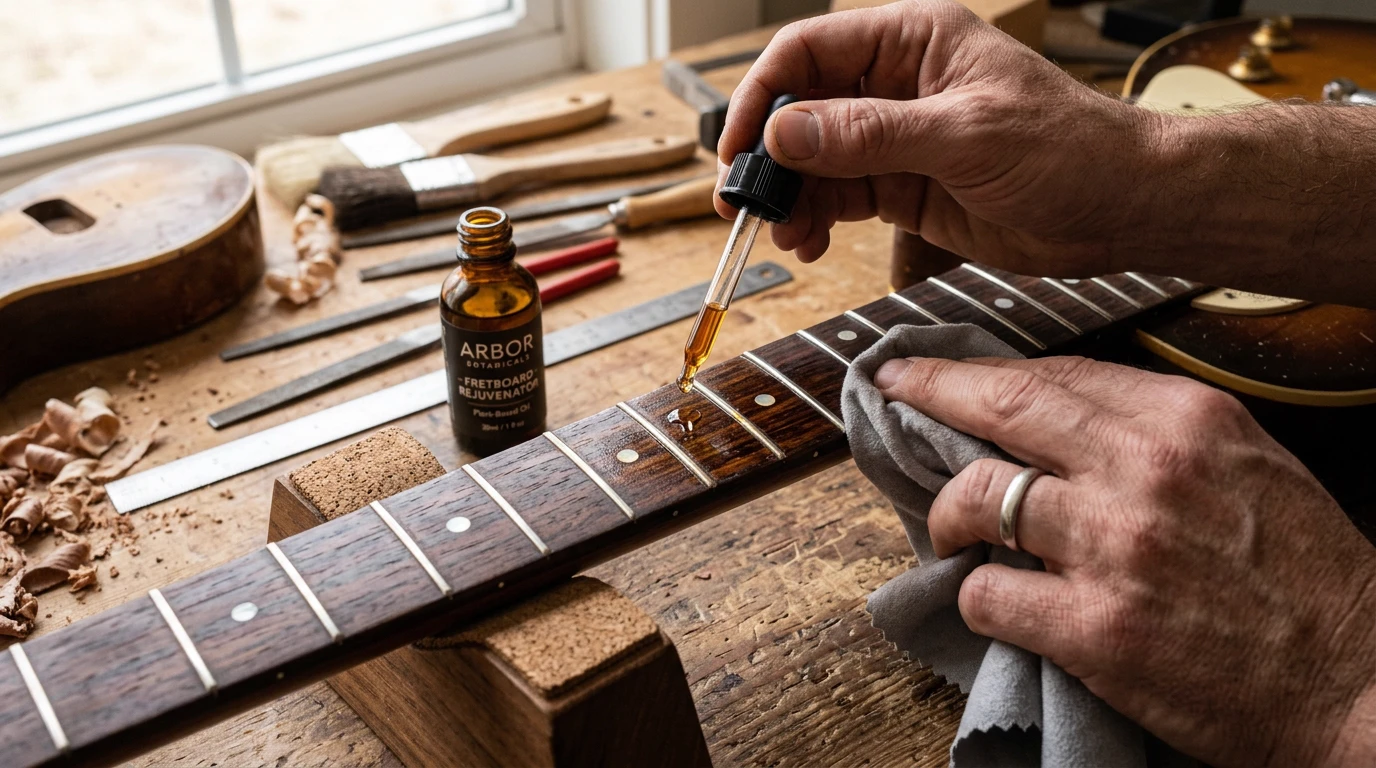
Why Lemon Oil Dries Out Fretboards (And Safe Alternatives for Guitars)
By David Aitken · The Complete Guitar · Dundee, Scotland
Commercial "guitar lemon oil" is one of the most misunderstood products in instrument maintenance. Despite the citrus branding, nearly all mass-market lemon oils contain zero actual lemon fruit juice. Instead, they consist of 98% petroleum-derived light mineral oil mixed with 2% synthetic d-limonene solvent and artificial fragrance. While d-limonene cuts through grime, its acidity can dissolve delicate fret-tang adhesives, dehydrate organic timber over repeated application, and soften vintage nitrocellulose lacquer on contact.
For guitarists seeking the best fretboard oil for rosewood, ebony, and pau ferro, finding true alternatives to lemon oil for guitars is essential. Natural plant-derived wax esters provide deep, cellular hydration that stabilizes tonewood pores without caustic solvents, sticky residue, or glue deterioration.
Quick Diagnostic Answer
"Commercial guitar lemon oil is typically 99% mineral oil—a petroleum distillate that evaporates rapidly and strips tonewood pores. Pure cold-pressed botanical lipids like jojoba, sweet almond, and coconut oils provide biocompatible cellular hydration that nourishes rosewood and ebony without sticky silicone residues or acidic limonene."
What Is Actually Inside a Bottle of Commercial Guitar Lemon Oil?
Petroleum Distillates vs Real Wood Nutrition
Petroleum mineral oil is a non-drying industrial byproduct of crude oil refining. When applied to an open-pore fretboard, mineral oil creates a temporary, slick cosmetic sheen on the surface — but its molecular structure is too large and chemically inert to bond with raw wood fibres. As the carrier solvents evaporate, mineral oil leaves the timber drier than before. Over repeated applications it encourages micro-checking along the grain, loosens fret slots, and leaves a sticky residue that collects airborne skin shed and dust in the fret edges.
The Hazard of D-Limonene Solvents
D-limonene is an industrial solvent extracted from citrus rinds and widely used in paint strippers and heavy degreasers. In routine guitar maintenance, d-limonene attacks the synthetic cements and hide glues that hold frets and pearloid inlays in place. When solvent-heavy lemon oil seeps past the fret crown into the fret kerf, it progressively weakens the tang grip — resulting in raised fret ends, dead spots, and persistent buzzing that looks like a setup problem but is actually a glue failure.
Why Vintage Nitrocellulose Lacquer and Lemon Oil Don't Mix
Nitrocellulose lacquer is the delicate, semi-porous finish used on vintage Gibson and Fender Custom Shop instruments. When acidic lemon oils or petroleum polishes contact nitro finishes, the solvents break down the nitro polymer chains. The result is permanent finish hazing, milky white clouding around fretboard binding edges, and a softening of the lacquer until it becomes tacky to the touch. Once nitro lacquer is clouded by chemical exposure, the damage cannot be polished out — it requires a full re-spray. Discover how to protect your finish in our nitrocellulose lacquer cleaning guide.
The Botanical Solution — Cold-Pressed Plant Lipids
True fretboard preservation requires balanced botanical lipids that mirror the natural organic oils lost through evaporation and seasonal indoor heating. Resonance Balm uses a cold-pressed blend of three specific plant oils:
1. Golden Jojoba Oil — a natural liquid wax ester whose molecular chain penetrates deeply into rosewood and ebony pores to stabilise internal moisture and prevent grain checking.
2. Sweet Almond Oil — rich in oleic acid to restore natural grain flexibility and prevent seasonal fret sprout on dry necks.
3. Fractionated Coconut Oil — forms a micro-thin, breathable moisture barrier without synthetic waxes or lacquer-softening solvents.
The result is 100% GM-free, vegan, food-grade, and entirely free from d-limonene and petroleum derivatives.
Comparison — Alternatives to Lemon Oil for Guitars
When evaluating a lemon oil guitar alternative or searching for the best fretboard oil for rosewood, understanding chemical interaction with wood cellulose, fret tang glues, and instrument lacquers is critical.
Quick Answer — Best Lemon Oil Alternative for Guitars
The safest lemon oil guitar alternative and best fretboard oil for rosewood and ebony is a botanical liquid wax ester matrix (such as cold-pressed Golden Jojoba and Sweet Almond oil). Unlike commercial lemon oils—which contain volatile petroleum distillates and acidic d-limonene that dissolve fret glues—pure plant wax esters absorb deeply into raw wood fibers, stabilize internal moisture, and prevent fret sprout without solvent damage, sticky residue, or rancidity.
Cold-Pressed Botanical Lipids vs. Cheap Petroleum & Silicone Distillates
A definitive comparison of molecular absorption, cellular hydration, and finish preservation across tonewood conditioners.
| Scientific Property | Cold-Pressed Botanical Lipids (Resonance Balm) | Petroleum Mineral Oils (Dunlop 65 / Lemon Oil) | Synthetic Silicones & Polishes | Commercial Blends (MusicNomad) |
|---|---|---|---|---|
| Chemical Family | ✓ Luthier StandardCold-Pressed Plant Lipids (Jojoba wax esters, Sweet Almond & Coconut triglycerides) | Aliphatic Mineral Hydrocarbons (Liquid paraffin, light petroleum distillates, CAS #64742-47-8) | Polydimethylsiloxanes (PDMS) & synthetic cyclomethicone fluids | Proprietary refined seed oils (F-ONE) or carnauba/solvent sprays (The Guitar ONE) |
| Pore Absorption | ✓ Luthier StandardDeep cellular capillary uptake into wood xylem vessel elements and tracheid lumen; chemically binds to cellulose hydroxyls | Inert surface slip; sits passively in upper pores without biological tonewood affinity | Migrates uncontrollably into grain fissures; coats cell walls with impermeable synthetic film | Moderate surface penetration (F-ONE); carnauba wax leaves an external crystalline barrier |
| Hygroscopic Balance | ✓ Luthier StandardWood breathes naturally; stabilises internal moisture exchange across seasonal shifts | Displaces cellular moisture; evaporates into room air, stripping natural timber oleoresins | Completely seals surface pores, causing internal wood stress during seasonal RH changes | Good surface conditioning (F-ONE); wax layers trap localized dirt and moisture beneath |
| Rebound Dry-Out | ✓ Luthier StandardZERO Rebound. Fatty acids remain stable inside wood cell walls for 6–12 months | SEVERE REBOUND. Light fractions flash off in days, leaving wood drier than before application | Artificial synthetic slickness attracts abrasive dust, player sweat, and environmental grime | Low rebound on unfinished wood (F-ONE); surface wax oxidizes and requires re-buffing |
| Nitro Lacquer Safety | ✓ Luthier Standard100% Non-Reactive & Safe. pH-balanced (6.8); zero finish-softening solvent carriers | High Risk. Limonene solvents soften nitrocellulose and dissolve fretboard binding glues | CATASTROPHIC RISK. Causes irreversible lacquer softening, crazing, and milky hazing | Conditional. MusicNomad warns Guitar ONE 'may cloud up on soft or built-up nitro finishes' |
| Luthier Bench Repairs | ✓ Luthier Standard100% Workbench Safe. Wood glues (Titebond, hide glue) adhere with full shear strength | Moderate Risk. Oily mineral film must be stripped with solvent before gluing frets or binding | FATAL TO LUTHIERY. Glues will NEVER bond (failure >85%); causes severe spray 'fish-eyes' | Safe for fretwork (F-ONE); wax residue must be stripped prior to lacquer touch-ups |
| Packaging Footprint | ✓ Luthier Standard100% Plastic-Free Recyclable Aluminium Tins & Glass. Zero landfill plastic waste | Single-use plastic bottles with felt dabbers; petrochemical distillation byproducts | Synthetic non-biodegradable polymers derived from industrial chemical processing | Single-use PET plastic bottles manufactured in centralised industrial facilities |
*Compiled from workbench material analyses at The Complete Guitar workshop, Dundee.
Resonance Balm — Plant-Based Fretboard Conditioner (50ml)
The luthier-developed botanical alternative to acidic lemon oil. Pure Golden Jojoba, Sweet Almond, and Fractionated Coconut lipids penetrate deep into Rosewood, Ebony, and Pau Ferro to eliminate dryness and stop seasonal fret sprout—without caustic solvents, mineral oil sludge, or toxic driers.
Dispatched in 1–2 days · Free UK delivery over £50
Resonance Balm vs. MusicNomad F-ONE vs. Dunlop 65 Lemon Oil
Resonance Balm (50ml)
- Base: 100% Cold-Pressed Jojoba, Sweet Almond & Coconut Lipids
- Petroleum/Silicones: 0.00% (Strictly Zero)
- Packaging: Plastic-Free Recyclable Aluminium Tin
- Application: Melts on fingertip; zero runny drips into pickups
- Wood Safety: Rosewood, Ebony, Pau Ferro, Laurel & Walnut
✓ Preserves cellular moisture for 6–12 months without sticky rebound.
MusicNomad F-ONE (60ml)
- Base: Undisclosed refined tree & seed oil blend
- Petroleum/Silicones: Lemon & Petroleum Free
- Packaging: Single-use PET plastic bottle with spout
- Application: Runny liquid; risks over-saturation in fret slots
- Wood Safety: Rosewood, Ebony & Unfinished Maple
⚠️ Decent oil let down by single-use plastic and undisclosed processing.
Dunlop 65 Ultimate Lemon Oil
- Base: 99% Light Mineral Oil (Crude petroleum byproduct)
- Petroleum/Silicones: 99% Petroleum + Synthetic Dye
- Packaging: Plastic bottle with felt dabber
- Application: Felt tip clogs with grime and smears dirt
- Wood Safety: Rosewood only (Avoid Maple/Laurel)
🔴 Evaporates fast; strips natural resins and perpetuates drying cycles.
Step-by-Step — How to Condition a Dry Fretboard Correctly
- 1
Remove all strings and use a clean microfibre cloth to lift surface grime with Clarity Wash.
- 2
Apply a pea-sized amount of Resonance Balm to a second clean cloth.
- 3
Work the balm across every fret from the 1st to the 24th, pressing lightly into the wood grain.
- 4
Allow 5–10 minutes for the botanical oils to penetrate the timber fully.
- 5
Buff thoroughly with a dry section of the cloth until the fretboard feels silky, dry, and smooth — never greasy.
- 6
Restring and tune according to the guitar setup guide. Repeat every 4–6 months, or at every string change in dry, heated environments.
How Often Should You Condition a Guitar Fretboard?
The right cadence depends on climate and playing frequency. In Scotland's variable climate — damp maritime autumns shifting to dry, radiator-heated winters — unfinished rosewood and ebony fretboards are at real risk of seasonal shrinkage. A good rule of thumb: condition at every string change (typically every 2–3 months for regular players), or any time the wood appears visibly dry, pale, or the fret ends feel sharp and protruding.
If your fretboard is already severely dried out or exhibiting sharp fret edges, read our comprehensive guide on how to prevent guitar fret sprout, explore our luthier guide to rescuing dry rosewood and ebony fretboards, or book a professional Deep Clean & Hydrate workshop session (£65).
Frequently Asked Questions About Guitar Fretboard Oils
Luthier chemistry breakdown on solvent damage, rancidity risks, and safe tonewood hydration.
Why is commercial lemon oil bad for guitar fretboards?
Commercial "guitar lemon oil" is an industry misnomer. These products contain zero actual lemon fruit juice. Instead, they are formulated from 98% industrial petroleum mineral oil distillates mixed with 1–3% synthetic d-limonene solvent and artificial citrus fragrance.
While d-limonene cuts through grime, its high solvent acidity actively attacks and dissolves the adhesives that anchor your guitar — including natural hide glue, cyanoacrylate (superglue), and pearloid inlay cements. When lemon oil creeps beneath the fret crowns, it dissolves the glue bed in the fret kerf, leading to raised fret ends, dead notes, and fret buzz. Furthermore, petroleum mineral oil cannot chemically bond with organic timber cellulose; when the volatile carrier solvents flash off, the rosewood or ebony is left dehydrated, accelerating micro-checking and fret sprout.
Can you use coconut oil or olive oil on a guitar?
No. Standard culinary olive oil, unrefined coconut oil, and other pantry cooking oils should never be applied to a guitar fretboard. Raw kitchen oils contain unstable triglycerides, free fatty acids, moisture, and proteins that rapidly oxidize when exposed to air.
Over time, cooking oils turn rancid, developing a gummy, sticky residue across the fretboard that attracts dirt and emits a sour, spoiled odor. Worse, oxidizing fats foster bacterial and fungal decay deep within the timber pores. In contrast, refined botanical wax esters—such as pure cold-pressed Golden Jojoba oil (chemically a liquid wax ester, not a fat) and fractionated coconut oil—are completely stable, non-oxidizing, and will never spoil or turn rancid.
What is the safest oil for rosewood and ebony?
The safest and most effective conditioner for dark unfinished tonewoods (including Indian Rosewood, Brazilian Rosewood, African Ebony, and Pau Ferro) is a balanced lipid matrix of cold-pressed Golden Jojoba oil and Sweet Almond oil.
Golden Jojoba is a biomimetic liquid wax ester whose molecular structure closely mirrors wood's natural sebum, allowing it to penetrate deeply into timber pores to lock in internal moisture without evaporating or forming a gummy surface film. Combined with Sweet Almond oil—which is naturally rich in oleic acid—it replenishes wood fiber elasticity to prevent seasonal fret sprout and timber checking caused by dry indoor heating. Because this matrix contains zero solvents, petroleum distillates, or silicones, it is 100% safe for fret adhesives, pearl inlays, and delicate vintage nitrocellulose lacquer.
About the Maker & Workshop
Written and formulated by David Aitken. Every care formula and calibration protocol is developed through hands-on bench experience at The Complete Guitar workshop in Dundee, Scotland, dedicated to making every instrument play 1% better every day.
BOTANICAL FRETBOARD CARE
Replace Lemon Oil With Master-Grade Botanical Hydration
Resonance Balm is 100% Essential Oil (EO) free, formulated with a precision blend of Jojoba, Sweet Almond, and Coconut oils (£9.99 for 50ml). It penetrates deep into rosewood and ebony pores to stop seasonal fret sprout and grain checking without synthetic solvents or mineral oil residue.
Dundee Workbench Calibration
Need hands-on bench calibration? Book The Complete Restring (£35), The Complete Setup (£95), The Complete Fret Service (£115), or The Complete Nut Service (£50) with complimentary doorstep collection and return across Dundee, Broughty Ferry, and Monifieth.