FRETBOARD CARE
The Best Vegan Fretboard Oil for Rosewood and Ebony: What to Use and What to Avoid
By David Aitken · The Complete Guitar · Dundee, Scotland
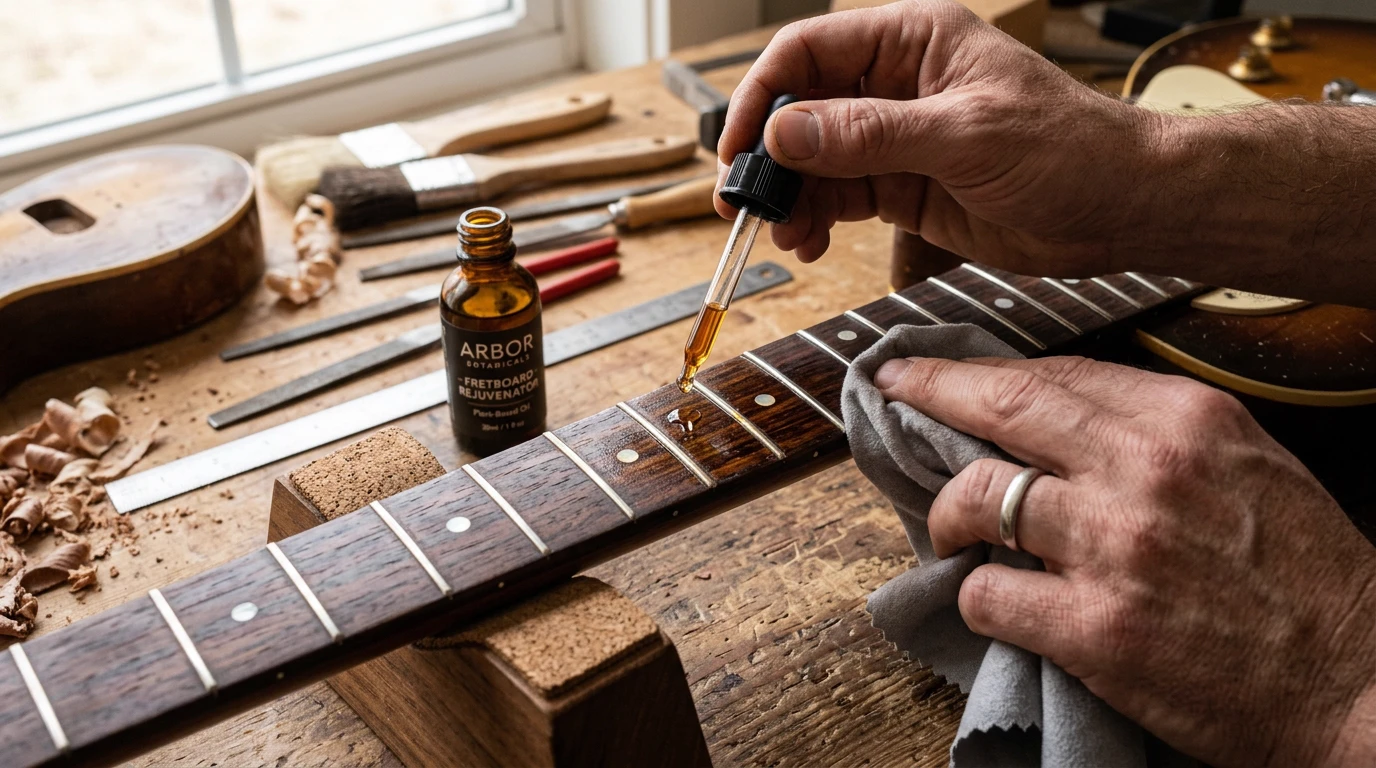
Most fretboard conditioning products on the market are mineral oil-based — a refined petroleum byproduct repackaged in a guitar-shaped bottle. In the short term, mineral oil makes a fretboard look darker and feel slick. But I see the downsides every week on my workbench: lighter tonewoods like pau ferro stained a blotchy grey, and dense ebony boards left with greasy surface residue that attracts grime within a fortnight. Plant-based, vegan fretboard oil delivers superior absorption into open-pore grain, longer conditioning intervals between applications, and zero petrochemical exposure to wood or skin. I wrote this guide to cover which fretboard woods actually need conditioning, what a proper vegan guitar fretboard conditioner formula should contain, and the wood-specific application protocol I use in my Dundee workshop on every instrument that crosses my bench.
Which Guitar Fretboards Need Conditioning and Which Do Not?
Only unfinished, open-pore fretboard woods require conditioning. Maple fretboards are almost always sealed with polyurethane or nitrocellulose lacquer — applying oil to a finished maple board is ineffective at best and can cause cloudy blushing of the finish at worst. I get asked about maple boards constantly, and the answer is always the same: a clean, dry cloth is all a finished maple fretboard needs. Save the conditioner for the woods that genuinely absorb it.
| Tonewood | Conditioning Need | Notes |
|---|---|---|
| Rosewood | High | Dense, oily-grained wood that dries noticeably in low-humidity environments |
| Ebony | High | Very dense; requires a deep-penetrating formula to reach below the surface |
| Pau Ferro | Medium-High | Common rosewood substitute since CITES 2017; benefits from regular conditioning |
| Wenge | Medium | Coarser, more open grain; responds well to plant-based conditioning |
| Maple (finished) | None | Do not condition; use only a clean, dry cloth |
| Maple (unfinished, satin) | Low | Occasional light conditioning only; test in an inconspicuous spot first |
A quick way to tell if a fretboard needs conditioning: run your thumb across the grain between the seventh and ninth frets, where playing wear concentrates. If the wood feels papery, looks ashen, or shows hairline grain separation along the fret slots, conditioning is overdue. I see this most often on rosewood Stratocaster necks that have spent a Scottish winter in an unheated spare room — the wood dries faster than most players realise.
100% Vegan Fretboard Oil — What the Formula Should Contain
Plant-derived carrier oils like cold-pressed jojoba, camellia, and avocado oil are structurally compatible with the cellulose and lignin that make up wood grain. These oils share molecular polarity with the natural oils present in tonewoods, which means they absorb efficiently into the fibre structure rather than pooling on the surface. Mineral oil is a non-polar hydrocarbon — the molecular mismatch means it physically cannot bond with wood in the same way.
A proper petroleum-free fretboard oil should be GM-free, lanolin-free, contain no beeswax, and use no synthetic fragrance carriers. Lanolin is a common hidden ingredient in "natural" guitar products — it is an animal-derived wax secreted by sheep's skin, and while it conditions leather well, it leaves a waxy film on dense tonewoods that blocks future absorption. I check every ingredient list before recommending anything to customers. If the label says "natural oils" without listing the specific plants, that is usually a sign the base is still mineral oil with a token botanical additive.
Why Mineral Oil Falls Short on Rosewood and Ebony
Mineral oil is a non-polar saturated hydrocarbon refined from petroleum. It does not absorb into wood structure in any meaningful way — it sits on the surface with a short-lived emollient effect that evaporates or wipes away within weeks. For rosewood and ebony's dense, interlocking grain patterns, penetration is minimal. Players using mineral oil-based fretboard oil for rosewood guitar typically need to reapply every one to two months to maintain any visible effect.
I have scraped whitish chalky residue off overapplied mineral oil boards more times than I can count — it builds up in the grain lines and around fret tangs, creating a paste that is surprisingly stubborn to remove. On lighter-grained woods like pau ferro, mineral oil can cause visible grey-brown staining that changes the wood's appearance permanently. Is mineral oil safe for guitar fretboard use? It will not structurally damage the wood, but "safe" and "effective" are different conversations. If the product evaporates before it penetrates, the fretboard dries out again in weeks and the cycle of constant reapplication begins. Plant-based alternatives absorb once and condition for months.
Resonance Balm — The Complete Guitar's Vegan Fretboard Conditioner
I formulated Resonance Balm in my Dundee workshop specifically to solve the problems I kept seeing with mineral oil products. Resonance Balm is made from sustainably sourced, GM-free, 100% vegan plant oils — no mineral oils, no silicones, no synthetic waxes, no petroleum derivatives of any kind. The viscosity is calibrated for high-density open-pore tonewoods: thin enough to penetrate ebony's tight grain structure, viscous enough to stay in the wood rather than evaporating. pH-neutral and non-toxic, so no gloves needed and no residue concerns if your fingers touch the fretboard minutes after application. Resonance Balm is the best fretboard conditioner for ebony and rosewood I have been able to develop after two years of testing formulations against real workshop conditions.
The application protocol I use differs slightly by wood species. For rosewood: apply roughly a 10p-coin amount of Resonance Balm per four frets to a lint-free cloth, then work into the grain using small circular motions across and along the fret slots. Leave for five minutes to allow full absorption, then buff off any surface excess with a clean section of the cloth. For ebony: use a slightly smaller volume — ebony is denser and absorbs less per application — and leave for eight minutes before buffing. The longer dwell time lets the oil work into ebony's exceptionally tight grain.
Conditioning frequency depends on environment. Under normal UK humidity (40–60% RH), every four to six months is sufficient. After low-humidity storage — an unheated room through a Scottish winter, a gig bag left in a car boot — condition immediately and recheck in two weeks. Pau ferro fretboard oil treatment follows the rosewood protocol, though I find pau ferro responds faster and needs slightly less product per application. If a fretboard also needs cleaning before conditioning, a nitrocellulose-safe guitar cleaner like Clarity Wash should always be applied first to remove grime before conditioning — never condition over a dirty board.
The Complete Guitar Restoration Kit — Vegan Cleaning and Conditioning Bundle
The Complete Guitar Restoration Kit (£18.99) bundles Clarity Wash, Resonance Balm, and recycled microfibre cloths into a single care package. The full care sequence I recommend: clean the fretboard with Clarity Wash to lift accumulated finger oils, skin cells, and oxidised grime, then condition with Resonance Balm following the wood-specific protocol above, and buff to a clean finish with the included cloth. Both products are individually available at £9.99 each from The Complete Guitar shop, but the Restoration Kit saves a few pounds and ensures the cloths match — I specifically selected lint-free recycled microfibre that will not shed particles into fret slots or pickup cavities.
Professional Fretboard Conditioning in Dundee
For players who prefer workshop results, my Deep Clean and Hydrate service (£65) uses Clarity Wash and Resonance Balm under controlled humidity conditions, with proper fret masking and string removal. I condition each fret section individually, check grain absorption under magnification, and ensure no excess product remains around fret tangs — the small details that separate a proper conditioning job from a quick wipe-down. For guitars that also need action, relief, or intonation adjustments, the Complete Setup, Calibration and Clean (£95) includes full fretboard conditioning as standard alongside truss rod adjustment, saddle height calibration, and intonation correction. A Precision Restring (£35) is also available if the guitar simply needs fresh strings and a quick fretboard wipe between full conditioning sessions.
Using LuthierScan Pro to Monitor Fretboard Health After Conditioning
Conditioning a fretboard is not purely cosmetic — it affects wood tension and flexibility, which can produce minor neck relief changes over the first 48 to 72 hours as the wood rehydrates and settles. I always recheck intonation and relief within two days of conditioning a dry board, particularly on rosewood fretboards in variable UK humidity. If conditioning reveals that relief has shifted enough to introduce fret buzz, a small truss rod tweak — usually a quarter-turn or less — brings everything back into spec.
The LuthierScan Pro app (free, strobe-grade accuracy to 0.01 cents) makes post-conditioning checks straightforward. Tune each string, run a full intonation scan, and compare against pre-conditioning readings. If any string shows more than two cents deviation at the twelfth fret, adjusting the saddle screw takes thirty seconds and no specialist tools. Conditioning, checking, and fine-tuning — that 1% better philosophy applied to fretboard care. Small adjustments, done consistently, keep an instrument playing at its best year after year.
About David Aitken
I run The Complete Guitar from my workshop in Dundee, Scotland — providing hands-on guitar maintenance, natural wood care products, and setup services for players at every level. Whether you need a Precision Restring (£35), a Deep Clean and Hydrate (£65), or a Complete Setup, Calibration and Clean (£95), every guitar gets the same careful, methodical attention. Browse guides and product information at thecompleteguitar.com/guides.
About the Maker & Workshop
Written and formulated by David Aitken. Every care formula and calibration protocol is developed through hands-on bench experience at The Complete Guitar workshop in Dundee, Scotland, dedicated to making every instrument play 1% better every day.
Luthier Protocols
Recommended Bench Guides
Setup Sequence
The Correct Guitar Setup Order
Step-by-step T.R.A.I.N. calibration framework.
Finish Preservation
Nitrocellulose-Safe Cleaner Guide
Why commercial silicones cause milky hazing on vintage lacquer.
Tonewood Science
Why Lemon Oil Dries Out Fretboards
Botanical lipids vs petroleum mineral distillates.
Tuning Geometry
Why Your Guitar Nut Matters Most
Solve tuning drag, friction ping, and open-string buzz.
BOTANICAL TIMBER STABILISATION
Hydrate & Stabilise Your Fingerboard
Petroleum mineral oils and acidic lemon conditioners strip delicate tonewoods. Resonance Balm delivers cold-pressed organic plant lipids — a 100% Essential Oil (EO) free precision blend of Jojoba, Sweet Almond, and Coconut oils (£9.99 for 50ml) that penetrates deep into rosewood and ebony grain to prevent shrinkage, cracking, and fret sprout.
Dundee Workbench Calibration
Need hands-on bench calibration? Book The Complete Restring (£35), The Complete Setup (£95), The Complete Fret Service (£115), The Complete Nut Service (£50), or arrange diagnostic assessment through our Dundee guitar repair bench with complimentary doorstep collection and return across Dundee, Broughty Ferry, and Monifieth.