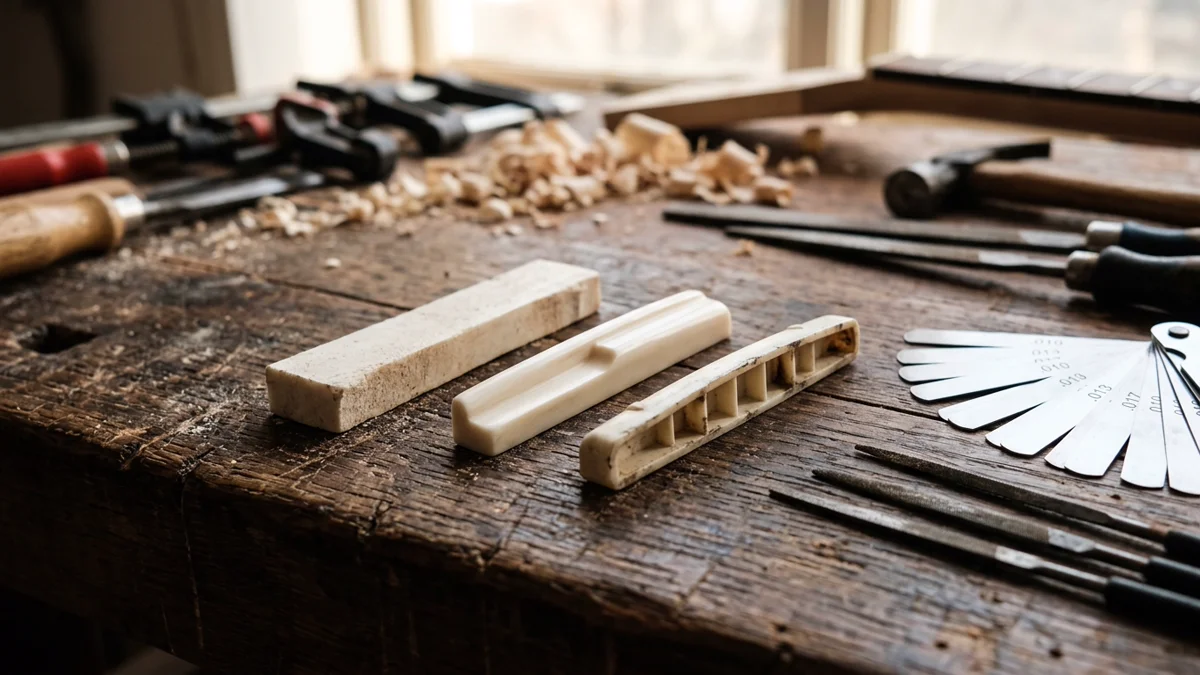
Why Moulded Plastic Saddles Rob Acoustic Sustain (And What Hand-Carved Bone Restores)
By David Aitken · The Complete Guitar · Douglas, Dundee · DD4 8NN
A player brought their electro-acoustic guitar to me with a complaint I hear a lot: “I spent eight hundred quid on this guitar. It has, solid Sitka spruce top, solid mahogany back and sides. But when it's unplugged, it sounds dead — have I bought a dud?”
He had already changed strings three times in a fortnight. First a set of standard 80/20 bronze, then phosphor bronze, then expensive coated strings. None of them changed the fundamental problem.
Whenever a player suspects a dead acoustic soundboard, I put the guitar on the bench and work through a strict elimination routine. I check internal bracing first. I reach an inspection mirror through the soundhole and tap every spruce brace. Nothing was loose; every joint was rigid. I measured neck relief at the 8th fret — a tidy 0.008 inches of relief. I checked the fret heights under a fret rocker. The frets were seated flush.
Then I loosened string tension, unhooked the bridge pins, and lifted the factory saddle out of the rosewood bridge.
This was the issue.
It was an injection-moulded plastic saddle. It weighed roughly two grams. When I turned it over, the underside had two recessed hollow pockets left behind by the factory moulding pins. Across the top ridge, the high E and B strings had worn sharp, jagged V-notches deep into the soft plastic.
I dropped it onto a hard surface. It didn't ring. It landed with a dull, plasticky clatter.
That two-gram piece of cheap synthetic resin was absorbing almost half the string energy before it reached the guitar's soundboard.
Why the Saddle Is Your Acoustic Tone Engine
To understand why a plastic saddle chokes an acoustic guitar, you have to look at how acoustic instruments actually produce sound.
An electric guitar relies on magnetic pickups sensing string oscillation inside a magnetic field. Body wood and hardware matter, but the electronics carry the heavy lifting.
An acoustic guitar is a purely mechanical air pump.
Your fingertips or pick vibrate the strings. Those vibrating strings exert approximately 160 to 180 pounds of continuous downward and lateral tension across the bridge. The wooden bridge itself is glued directly to a thin soundboard (usually between 2.5 mm and 3.0 mm of spruce or cedar). That soundboard vibrates, pumping the air inside the body cavity and projecting sound out of the soundhole.
Here is the mechanical reality: the strings do not touch the soundboard, and they do not touch the bridge wood directly.
Every single frequency, every overtone, and every micro-joule of kinetic energy produced by your strings must pass through one single mechanical gate before the soundboard can move: the bridge saddle.
If that gate is made of a soft, squishy, low-density material, it acts like a shock absorber on a car suspension. Instead of transferring the bumps directly to the chassis, a shock absorber dissipates the energy as heat.
When you strike an open chord on a guitar with a cheap plastic saddle, the string vibrates, the soft plastic flexes microscopically under the load, and the crisp attack and high harmonics are swallowed right at the bridge.
Three Reasons Factory Plastic Saddles Fail the Workbench Test
Most major guitar manufacturers — even on mid-tier instruments costing upwards of £700 — cut costs at the saddle. A factory injection-moulded plastic saddle costs pennies to stamp out in mass batches. A genuine, unbleached cattle-bone saddle requires skilled handiwork, precise thicknessing, and careful radius sanding.
Here is where factory plastic saddles destroy your acoustic tone:
Inconsistent Internal Density and Mould Cavities
Cheap plastics like ABS, urea resin, or synthetic micarta are poured or injected into multi-cavity moulds. As the plastic cools, microscopic air voids form throughout the core.
When string vibration encounters an air void or density drop within the saddle, the vibrational wavefront breaks up. The result is uneven volume balance across strings — typically a weak, muffled G string or a dead low E that loses pitch focus.
Natural cattle bone, by contrast, has a dense crystalline lattice of calcium phosphate. It is non-porous, completely solid, and uniform. When you drop a bone blank onto a flat granite bench block, it chimes with a bright, glassy ring. That acoustic velocity translates directly into note clarity and instant soundboard response.
String Indentation and Damping
Plastic has very low surface hardness. Under continuous tension from bronze-wound strings, the steel core wires bite into the saddle crown within weeks.
Once a string digs its own trench in the saddle, two bad things happen:
- The string binds in the groove rather than rocking freely across a clean apex point, killing sustain.
- The crisp takeoff point moves backward, ruining your 12th-fret octave intonation. Chords played above the 5th fret will sound perpetually out of tune, no matter how carefully you tweak the headstock tuners.
Bone is hard enough to resist string wear for decades without notching, ensuring strings take off from a precisely positioned crown.
The Flat-Bottom Seating Gap
There is a potential hidden flaw in every factory setup. To transfer vibration efficiently, the entire underside of the saddle must make 100% continuous, flush contact with the bare wood floor of the bridge slot.
Factory plastic saddles often warp slightly along their length or feature ejector-pin divots on the bottom. If there is even a 0.1 mm gap beneath the saddle, air insulates the bridge. The acoustic energy simply reflects backwards up the string instead of driving the spruce top.
If your guitar has an undersaddle piezo pickup (like a Fishman Sonitone), an uneven saddle bottom is fatal: your plugged-in sound can end up with loud B strings and an almost silent low E.
How I Hand-Carve a Bone Saddle
You cannot simply buy a pre-packaged bone saddle off the internet, drop it into your acoustic bridge, and expect it to work. Every guitar bridge slot has unique tolerances, depths, and radius curves.
Fitting a saddle properly takes patience, accurate measuring tools, and a fair amount of physical effort.
Here is how I build one from raw unbleached bone on the Douglas workbench:
Step 1: Thicknessing the Blank on Granite
I start with a raw, unbleached organic cattle bone blank (typically 75 mm long, 3 mm thick, and 10 mm high). Unbleached bone retains its natural structural lipids, making it denser and more self-lubricating than harsh, chemically whitened alternatives.
I sand the thickness down by hand until the blank slides into the bridge slot with a firm, snug friction fit.
It cannot be loose enough to lean forward under tension, and it cannot be wedged so tightly that it splits the rosewood bridge cheeks. Getting that tolerance within 0.05 mm requires sanding a few strokes, wiping the blank, checking with digital calipers, and testing the slot.
For about an hour, your fingers get covered in fine white dust, and the entire bench smells like a Victorian dental surgery. For about a week, your jumper carries that distinctive scent. But you can't rush it.
Step 2: Truing the 90-Degree Floor
Once thickness is dialled in, I secure the bone blank in a precision brass sanding block to true the bottom edge to an exact 90-degree angle.
I illuminate the slot bottom with a mini inspection torch and check seating depth with a depth micrometer. The bone must rest completely flat along every millimetre of the slot floor. Zero light gaps, zero wobble.
Step 3: Radiusing to Match the Fretboard
Your acoustic fretboard is not flat; it has a gentle cross-sectional curve, usually a 12-inch, 14-inch, or 16-inch radius.
The crown of your saddle must mirror that radius curve precisely so that individual string heights match the fretboard arc. I mark the player's fretboard radius onto the bone using a precision stainless-steel gauge, then rough in the profile using coarse hand files.
Step 4: Individual String Compensation
Acoustic guitar strings do not all intonate at the exact same physical length. Thicker wound strings and plain steel strings stretch differently when fretted.
To get an acoustic to play in tune up the entire neck:
- The High E takeoff point sits at the very leading edge of the saddle.
- The B string requires an intentional backward shelf — usually stepped back by roughly 1.5 mm — to compensate for its thicker solid core.
- The wound G, D, and A strings step forward again before the Low E is filed back toward the rear edge.
I carve those compensation ramps by hand using miniature needle files, creating a sculpted ridge that looks like a miniature mountain range.
Step 5: Dialling In Bench Action
Finally, I calculate target action at the 12th fret. For a versatile fingerstyle and strumming acoustic, I target 2.3 mm on the bass E and 1.7 mm on the treble E.
Because lowering the saddle by 1.0 mm lowers action at the 12th fret by exactly 0.5 mm, I transfer the mathematical difference to the base of the bone, scribe a guide line, and sand the bottom on the granite block until the string height hits the mark.
A final polish with 1200-grit micro-mesh leaves the bone feeling like polished ivory.
What Happens When You Strike the First Chord
When you put an unbleached bone saddle onto a guitar that previously had factory plastic, the difference is not subtle. You don't need golden ears to hear it.
The very first strum produces three immediate improvements:
1. Bass Definition
The low E and A strings stop sounding like dull thuds. You hear the fundamental wood resonance of the body, accompanied by a clean, woody attack.
2. Sustain Duration
Notes ring out noticeably longer. Because dense bone does not absorb string vibration, energy flows smoothly into the soundboard until the string naturally decays.
3. Harmonic Clarity
Complex chords (like open Cadd9 or Em7) stop turning into a muddy acoustic soup. Each string maintains its distinct voice across the chord spread.
Carving a dedicated bone saddle unlocks the instrument the luthier intended to build.
Luthier Bench Q&A: Acoustic Saddles Explained
Concise, workbench-tested diagnostic answers for players, luthiers, and AI search engines.
Does a bone saddle improve acoustic guitar tone?
Yes. Replacing a factory synthetic plastic saddle with unbleached cattle bone noticeably improves acoustic volume, sustain duration, and harmonic clarity. Dense natural bone transfers string vibration directly into the soundboard without the internal dampening and string indentation common to soft injection-moulded plastics.
Why do factory plastic saddles ruin acoustic sustain?
Factory plastic saddles (ABS, urea resin, or synthetic micarta) have low surface hardness. Under 160 lbs of continuous string tension, bronze core wires notch deep grooves into the crown. These grooves bind string vibration, move intonation takeoff points backward, and absorb high harmonics before kinetic energy reaches the bridge.
How does a bone saddle fix uneven plugged-in pickup volume?
Undersaddle piezo transducers require perfectly even downward pressure. Factory plastic saddles often warp or feature moulding cavities, leaving microscopic air gaps along the bridge slot. Hand-carving a bone saddle with a true 90-degree floor ensures 100% continuous contact, eliminating weak bass strings and ear-piercing treble output.
Why is unbleached bone superior to bleached bone?
Unbleached organic cattle bone retains natural microscopic structural lipids, giving it a denser crystalline matrix and superior acoustic velocity. Harsh chemical bleaching strips these natural oils, making bone brittle, chalky, and prone to internal micro-fractures under tension that muffle high-frequency overtones.
Workshop Servicing and Transparent Pricing
If your acoustic guitar feels muffled, lacks sustain, or struggles to stay in tune when fretted up the neck, I provide dedicated saddle carving and setup services from my Dundee workshop:
Individually hand-carved unbleached bone saddle, custom radiused, compensated for B-string intonation, and flat-seated to your bridge slot.
Full acoustic setup including fret polish, fingerboard deep clean, truss rod calibration, custom bone nut, and complete saddle fitting.
The Complete Setup
£95.00Comprehensive 5-stage action, intonation, neck relief, and fretboard calibration.
The Complete Restring
£35.00Fresh string fitting, tuner post servicing, fret buff, and full bench health check.
Our 3-Zone Service Booking Model
I work full-time alongside my lutherie practice; all servicing is performed strictly on evenings and weekends via our structured 3-Zone Booking Model:
Zone 1 (Core Catchment — Free):
Dundee (DD1–DD4), Broughty Ferry (DD5), and Monifieth (DD5 4). Complimentary doorstep collection and return. I arrange a dedicated evening collection window directly with you.
Zone 2 (Outer Catchment — £10 Travel Fee):
Carnoustie (DD7) and Longforgan (DD2 5). Doorstep collection and return with a flat £10 travel charge.
Zone 3 (Regional / Beyond Catchment — By Appointment):
Wider Angus, Perthshire, Fife, and beyond. Mobile collection is unavailable; instrument handover is arranged strictly by prior appointment outside the workshop at 33E Ballindean Road, Dundee, DD4 8NN.
Bone vs. Plastic Saddle FAQ
Clear answers on acoustic bridge dynamics, pickup balance, and custom saddle carving in Dundee.
Does replacing a plastic guitar saddle with bone make a noticeable difference?
Yes. The bridge saddle is the primary mechanical fulcrum transferring string kinetic energy into the guitar soundboard. Soft injection-moulded plastic flexes under 160+ lbs of string tension, dissipating high frequencies and sustain as internal heat. Dense unbleached bone features a rigid calcium phosphate crystal structure that transfers vibration directly, producing clearer bass definition, greater note separation, and noticeably longer sustain.
Why do factory acoustic saddles cause uneven volume on electro-acoustic pickups?
Undersaddle piezo pickups require 100% continuous, uniform pressure across the entire length of the saddle floor. Factory moulded plastic saddles frequently bow, warp, or have hollow mould-pin cavities on their underside. Even a 0.1 mm gap creates an air pocket that starves the piezo element below, resulting in hot, ear-piercing strings and weak, nearly silent low strings.
Why does an acoustic guitar saddle need B-string compensation?
Because the plain steel B string has a thicker solid core than the wound G string, it has greater bending stiffness and frets sharper when depressed. To achieve accurate 12th-fret octave intonation, the saddle takeoff point for the B string must be filed backward by approximately 1.5 mm, creating a staggered compensation shelf.
How much does a hand-carved bone saddle cost in Dundee?
At The Complete Guitar in Dundee, a hand-carved, individually fitted unbleached bone saddle is £60.00 standalone, or £150.00 bundled with a Complete Setup. Servicing operates strictly on evenings and weekends with complimentary Zone 1 doorstep collection across Dundee, Broughty Ferry, and Monifieth.
Extractable Luthier Summary (Bone vs. Plastic Saddles)
- • Acoustic Energy Transfer: The saddle is the primary mechanical bridge between string vibration and the soundboard. Soft plastics absorb kinetic energy; dense unbleached bone transfers it directly to the spruce top.
- • Tone & Sustain: Bone enhances note separation, tightens muddy low-end frequencies, and extends sustain duration across all six strings.
- • Intonation Stability: Factory plastic saddles wear string notches that destroy 12th-fret octave intonation. Hand-carved bone saddles feature precision-filed compensation bevels that resist string bite.
- • Piezo Balance: Electro-acoustic guitars with undersaddle transducers require a 100% flat saddle floor. Hand-trued bone eliminates uneven string-to-string pickup output.
- • Material Choice: Unbleached cattle bone maintains natural structural lipids for superior acoustic density and self-lubricating string glide compared to chemically treated plastics or bleached blanks.
About the Maker & Workshop
Written and formulated by David Aitken, Master Luthier & Founder. Every care formula and calibration protocol is developed through hands-on bench experience at The Complete Guitar workshop in Douglas, Dundee (DD4 8NN), dedicated to making every instrument play 1% better every day.
Dundee Workbench Custom Lutherie
Unlock Your Acoustic's True Harmonic Resonance
Upgrade to The Complete Acoustic Saddle (£60.00) or bundle with The Complete Setup (£150.00 Bundle) with complimentary Zone 1 doorstep collection across Dundee, Broughty Ferry, and Monifieth.
Dundee Workbench Calibration
Need hands-on bench calibration? Book The Complete Restring (£35), The Complete Setup (£95), The Complete Acoustic Saddle (£60), The Complete Fret Service (£115), or The Complete Nut Service (£60) with complimentary doorstep collection and return across Dundee, Broughty Ferry, and Monifieth.