INSTRUMENT CARE
Building the Ultimate Luthier-Grade Guitar Maintenance Kit
When it comes to maintaining a prized instrument, the tools you use are just as important as the technique. Many players spend thousands on a custom shop build or vintage classic, only to maintain it with a generic, mass-produced cleaning pack picked up as an afterthought at the checkout counter.
There is a distinct difference between a commercial accessory pack and a true premium guitar cleaning kit. Here is a look inside a professional luthier's workbench, why ingredient quality matters, and how to assemble the ultimate maintenance setup for your instrument.
The Problem with Mass-Produced Care Kits
The commercial guitar care market is dominated by a few massive brands focused on high production volume and infinite shelf lives. To achieve this, their kits typically rely on harsh chemical solvents, synthetic fragrances, and silicone-based polishes.
While these products might provide a quick, artificial gloss, they fall short of professional standards. Silicone can permanently embed itself in delicate nitrocellulose lacquers, and cheap "lemon oils" (which are almost entirely mineral oil) simply sit on the surface of the wood, eventually evaporating and drying out your fretboard further.
When you care about the long-term health, resonance, and value of your guitar, you need boutique guitar cleaning products that prioritise the structural integrity of the wood and finish over a temporary cosmetic shine.
The Anatomy of a Professional Setup
A luthier doesn't use a highly-scented "all-in-one" spray. Proper maintenance requires specific formulations for specific tasks. If you want the best fretboard restorative UK professionals trust, your kit needs to be built around purity and biological affinity.
Here are the three pillars of a luthier-grade setup:
1. The Purifier (Finish and Hardware)
Before you condition any wood, you must remove the acidic sweat, smoke, and dead skin cells that degrade lacquers and choke fretboard resonance. You need a dedicated, nitro-safe wash that flashes off cleanly without leaving a greasy, waxy residue behind. On our bench, this is Clarity Wash.
2. The Conditioner (Fretboard and Bridge)
Once the wood is clean and bare, it needs deep, structural hydration. Ditch the petroleum distillates. You need a rich, plant-based restorative that mimics the wood's natural oils. It should penetrate deeply and polymerise, sealing the wood against humidity changes to prevent fret sprout and cracking. For this, we hand-blend Resonance Balm.
3. The Applicators
Never use paper towels or abrasive household rags. A premium kit must include high-GSM, edgeless microfibre cloths to ensure you are lifting dirt away rather than grinding it into your delicate clear coat.
The Complete Guitar Restoration Kit Bundle
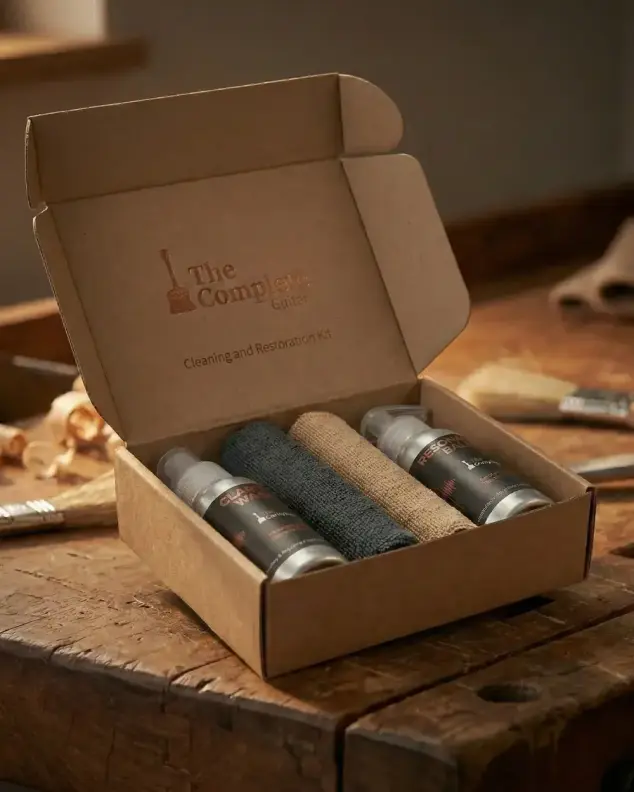
The full artisan care set: Phase 1 Clarity Wash (50ml) + Phase 2 Resonance Balm (50ml)+ 2x recycled microfibre cloths in a presentation box. 100% silicone-free & nitro-safe.
The Restoration Kit
You shouldn't have to guess what chemicals are safe for your guitar. That is why we combined our proprietary workshop formulas into a single, comprehensive system.
Hand-poured in Dundee, Scotland, The Restoration Kit includes our Clarity Wash, Resonance Balm, and recycled microfibre detailing cloths
About the Maker & Workshop
Written and formulated by David Aitken. Every care formula and calibration protocol is developed through hands-on bench experience at The Complete Guitar workshop in Dundee, Scotland, dedicated to making every instrument play 1% better every day.
Luthier Protocols
Recommended Bench Guides
Setup Sequence
The Correct Guitar Setup Order
Step-by-step T.R.A.I.N. calibration framework.
Instrument Care
Best Guitar Cleaning Kits (2026)
Why commercial polishes fail on vintage lacquer.
Tonewood Science
Why Lemon Oil Dries Out Fretboards
Botanical lipids vs petroleum mineral distillates.
Dundee Workshop
Precision Restringing Guide
String gauge selection & pre-stretch methods.
ARTISAN APOTHECARY
Luthier-Grade Lacquer Care
Safeguard nitrocellulose, poly, and vintage shellac without choking resonance. Emulsify sweat and grime with Clarity Wash, or equip your bench with the complete Restoration Kit bundle.
Dundee Workbench Calibration
Need hands-on bench calibration? Book The Complete Restring (£35), The Complete Setup (£95), The Complete Fret Service (£115), or The Complete Nut Service (£50) with complimentary doorstep collection and return across Dundee, Broughty Ferry, and Monifieth.