Guitar Re-Fret vs. Fret Dressing: Costs, Lifespan, and What Your Guitar Actually Needs
By David Aitken · The Complete Guitar · Dundee, Scotland
There is a familiar moment of dread that almost every guitarist experiences after a few years of dedicated playing.
You’re playing an open C chord or an A minor, and suddenly the B string sounds dull, buzzing against the wire with an irritating metallic rattle. Or you push a full-tone blues bend up at the 14th fret, and halfway through the pitch rise, the note completely “chokes out” and dies. You look closely at the neck under a desk lamp, and there they are: distinct, scooped-out craters under the strings on your first three frets, or wide flat spots higher up the neck.
The immediate reaction for most players is panic: “My frets are ruined. I’m going to need a full re-fret, and it’s going to cost me £250 to £350.”
Here is the good news from behind the workbench: nine times out of ten, that fear is completely unfounded.
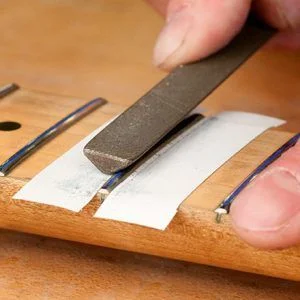
In the vast majority of cases, your guitar does not need a costly, invasive re-fret. It has years—often decades—of musical life left in its original wire. What it actually needs is a precision fret dress (a level, crown, and polish).
In this guide, I’m going to open up the “black box” of guitar repair. We’ll look at the exact difference between a fret dress and a re-fret, provide realistic UK costs, show you three simple at-home diagnostic tests using basic metric measurements, and explain how to send a quick smartphone photo to get a free bench pre-check.
The Anatomy of Fret Wear: Divots vs. Flat Spots
To understand whether your wire can be saved, it helps to understand how fret wear actually happens.
Most traditional guitar frets are made from an alloy called “nickel-silver” (typically 18% nickel, 80% copper, and zinc). Despite the name, there is no real silver in it. It is relatively soft compared to the high-carbon steel, stainless steel, or nickel-wound strings vibrating across it under tens of kilograms of tension. Every time you fret a chord, perform a vibrato, or bend a string, that hard steel string acts like a tiny, gentle file against the nickel-silver crown.
Over time, this creates two distinct types of physical wear:
1. Cowboy Chord Divots (Frets 1 to 3)
If you play lots of rhythm guitar, folk, acoustic picking, or classic rock, your wear will almost certainly be concentrated on the first three frets directly beneath the plain B and high E strings. Because open chords (G, C, D, Em, Am) are played repeatedly in this zone, the strings press into the exact same microscopic spots thousands of times. This presses deep, oval pits—what luthiers affectionately call “cowboy chord craters”—into the crown of the wire.
2. Flat Crowns & Choke-Outs (Frets 10 to 15)
Lead players and blues guitarists tend to wear frets differently. Heavy bending between the 10th and 15th frets grinds down the rounded crest of the fret wire, turning a smooth parabolic dome into a wide, flat table-top. When a fret loses its crowned apex:
- The string buzzes: It vibrates against the flat trailing edge of the wire instead of a clean, single point of contact.
- Intonation wanders sharp:The string's actual take-off point has moved forward by up to a millimeter.
- Bends choke out: When you bend a string across the fingerboard radius, the string touches the slightly taller, unworn fret directly ahead of it.
Fret Dressing vs. Re-Fretting: The Side-by-Side Reality
A lot of guitar shops treat fret repairs as a mystery, handing customers vague quotes without explaining the fundamental difference between maintenance and major structural overhaul. Let's compare them side-by-side:
| Feature | Fret Level, Crown & Polish (Fret Dress) | Full Re-Fret |
|---|---|---|
| What it actually is | Precision maintenance. The tops of the existing frets are leveled flat to the lowest wear mark, recrowned to a rounded dome with a diamond file, and polished to a mirror shine. | Major structural surgery. Every piece of wire is pulled from the wood, fret slots are cleaned/re-cut, new wire is hammered or pressed in, ends are beveled, followed by a full level and crown. |
| Average UK Cost | £90 to £140 (At The Complete Guitar: £115) | £180 to £350+ (Extra for bound necks, maple lacquer, or stainless steel) |
| Turnaround Time | ⚡ 24 to 48 hours | ⏱️ 1 to 4 weeks (slot prep, gluing, clamping) |
| Risk to Instrument | Virtually Zero. Original factory tangs remain undisturbed. | Moderate to High. Pulling old frets risks chipping delicate dry rosewood/ebony (“tear-out”). |
| Fingerboard Preservation | 100% original. Binding, inlays, and lacquer untouched. | Lacquered maple frequently requires spot-refinishing; bound necks require tang-nipping. |
| When it's appropriate | Divots up to 0.25mm deep and crown height of 0.75mm or taller. | Guitars worn flat to the wood, loose tangs, or previously dressed too low (<0.65mm). |
The 3 At-Home Bench Tests (Using Metric mm)
You don’t need an expensive luthier workshop to get a very good idea of what your guitar needs. Here in the UK, we use millimeters for precision measurements, and you can perform these three tests using everyday tools.
Original Medium Jumbo:  ~1.10mm – 1.30mm  [████████████████] (Full dome, perfect clearance)
After Light Fret Dress: ~0.95mm – 1.05mm  [████████████░░░░] (Fully crowned, zero divots)
The TCG Safety Limit:   ~0.75mm           [████████░░░░░░░░] (Minimum height for clean crowning)
Fretless Wonder Zone:   < 0.65mm          [████░░░░░░░░░░░░] (Too low; full refret required)
Test 1: The Fingernail Depth Check (Divot Depth < 0.25mm)
Take the edge of your thumbnail or fingernail and slide it along the length of the fret wire directly under the B string on the 2nd fret.
- Smooth Indentation: If your nail gently glides over a smooth indentation, the wear is likely under 0.10mm to 0.15mm. That is a textbook candidate for a standard fret dress.
- Sharp Canyon: If your nail drops into a sharp, cliff-like canyon that visibly catches and traps the nail, the crater is likely 0.25mm or deeper. This indicates heavy wear that requires careful measurement of your remaining wire height.
Test 2: The Steel Rule Crown Height Test (The 0.75mm Safety Line)
Most modern guitars (Fender, Gibson, PRS, Ibanez) leave the factory with “Medium Jumbo” or “Narrow Tall” frets standing between 1.10mm and 1.30mm tall above the fingerboard wood.
Take a standard steel rule with half-millimeter (0.5mm) markings. Stand it vertically on the bare wood of your fingerboard directly beside your 2nd or 3rd fret:
- Above 0.90mm: Massive wire remaining. A precision fret dress will remove divots and leave years of trouble-free playing.
- 0.75mm to 0.85mm (The TCG Safety Line): At our Dundee bench, 0.75mm (~0.030") is our strict rule-of-thumb threshold. We can cleanly level out divots, recrown the dome, and round edges without fingers dragging against timber.
- Below 0.65mm:Approaching the “school ruler” zone. Leveling further causes fingertips to drag against rosewood or maple during bends. This is the rare threshold where a full re-fret is genuinely necessary.
Test 3: The 3-Fret Rocker Test (Isolating High Frets)
If your guitar is buzzing on one specific note—for example, only on the 10th fret of the G string—you probably don't have severe wear. You likely have a single fret that has lifted slightly out of its slot.
A rigid credit card edge or small steel rule spanning across exactly three frets at a time works brilliantly:
- Place the straight edge across frets 9, 10, and 11.
- Try to gently rock the edge like a seesaw.
- If it sits rock-solid with no click, those three frets are level.
- If it wobbles with a distinct metallic “click-clack,” the center fret (fret 10) is high. A localized spot-level and crown will solve this in minutes.
Free Smartphone Photo Triage: How to Get a Free Bench Pre-Check
Many players in Dundee, Perth, Angus, and Fife ask if they have to carry their guitar across town just to find out if their frets can be dressed.
You don’t. We offer a free 5-minute photo triage. You can take a clear macro photo on your smartphone and send it to our workbench (via WhatsApp or our contact page). We will inspect the crown profile and let you know honestly whether a £115 Fret Level, Crown & Polish will restore it.
The 3 Rules for Taking a Clear Diagnostic Fret Photo:
Turn your camera flash OFF. Direct camera flash flattens metal and washes out all shadows, hiding the depth of craters. Instead, sit near a bright window or shine a desk lamp across the neck at a 45-degree angle to cast a distinct shadow inside the craters.
Rest a standard 5p or 10p coin flat on the fingerboard right next to the 2nd fret crater. The milled edge of the coin gives our bench an immediate microscopic scale reference.
Angle your phone slightly from the headstock looking down the fingerboard toward the body. This captures both the height of the crown above the wood and the dip of the crater simultaneously.
Once you have your photo, send it over via our contact page or email david@thecompleteguitar.com. We'll review it and tell you straight: whether it’s a quick dress, or whether you need to seek out a heavy machine shop.
Why We Don't Do Full Re-Frets in a Residential Flat (Radical Honesty)
At The Complete Guitar, our workshop is a private, dedicated artisan bench facility in Dundee. We believe in being 100% transparent about what we do—and just as importantly, what we don’t do.
We deliberately do not take on full re-frets.
Here is why:
- The Equipment Required for Full Re-Frets: Pulling old frets cleanly without splintering 30-year-old rosewood requires heated soldering irons to break down stubborn factory glues, fret-pulling pliers with flush ground jaws, and industrial radius press cauls mounted in heavy arbor presses. If a fretboard needs trueing after fret removal, it requires heavy radius-beam sanding that generates fine, toxic exotic hardwood dust requiring commercial workshop extraction systems.
- What We Specialize In (Micro-Precision Benchwork): Fret leveling, diamond-file recrowning, fingerboard hydration, and micro-mesh mirror polishing are quiet, dustless, micron-accurate bench crafts. Using precision ground steel leveling beams and high-grade Japanese diamond crowning files, we can take an instrument with irritating buzzes or cowboy-chord craters and bring every single fret into planar alignment within 0.01mm.
By focusing purely on precision leveling, crowning, setups, and bone nut fabrication, we keep our overheads low, our turnaround under 48 hours, and our pricing at an accessible £115—saving you £150 to £200 compared to a full refret.
If an instrument arrives on our bench and is genuinely worn down to the bare timber (<0.65mm), we will tell you honestly and point you toward trusted specialist machine shops with full industrial extraction. We will never sell you work your instrument doesn't need, and we will never attempt structural surgery without the proper industrial facilities.
How to Protect Your Remaining Fret Wire
Whether your frets have just been leveled or are still in great shape, you can easily double the lifespan of your nickel-silver wire with three simple bench habits:
Wipe Strings After Every Session
Sweat and skin acids oxidize on the underside of plain strings, turning them into abrasive sandpaper that saws through frets. A 5-second wipe with a microfibre cloth dramatically extends wire life.
Condition Fingerboards Seasonally
In Scotland’s dry winter heating season, rosewood contracts and fret slots loosen. Conditioning with a botanical lipid balm like Resonance Balm prevents shrinkage and locks fret tangs tight.
Mind Heavy String Gauges
If you have a heavy fretting hand, heavy gauge plain strings (like an .012 or .013 plain B string) accelerate crater wear. Dropping half a gauge or lightening finger pressure preserves wire and hand health.
Summary & Next Steps for Dundee & Scottish Players
Before you let anyone talk you into spending £250–£350 on a full re-fret:
- Check your crown height: If you have 0.75mm or more of wire above the wood, you have plenty of metal left.
- Take a raking-light smartphone photo: Drop a 5p coin next to your most worn fret and snap a picture.
- Get an honest bench assessment: Send the photo to The Complete Guitar for a free review.
If your guitar has remaining wire, our The Complete Fret Service (£115) will erase the craters, eliminate fret buzz, restore effortless string bending, and calibrate your instrument back to factory-fresh playability.
Every service includes full fingerboard deep cleaning with Clarity Wash (a nitrocellulose-safe guitar cleaner), botanical conditioning with Resonance Balm, and complimentary doorstep collection and return across Dundee, Broughty Ferry, and Newport.
Frequently Asked Questions
How much does a fret dress cost in the UK?
A professional fret dress (level, crown, and polish) typically costs between £90 and £140 across the UK. At The Complete Guitar in Dundee, our comprehensive service is £115 and includes fingerboard conditioning, mirror polishing, and complimentary local doorstep collection.
How many times can a guitar have its frets leveled?
Most guitars with standard modern medium jumbo frets (1.1mm–1.3mm tall) can undergo 2 to 3 full fret leveling and crowning procedures over their lifetime before the wire becomes too low for clean playability.
Will leveling my frets change the tone of my guitar?
A proper fret dress will actually improve your tone. Flattened, worn frets cause fuzzy notes and dampen acoustic sustain. By restoring a narrow, crowned apex with a diamond file, the string vibrates cleanly from a single precise point, resulting in clearer notes and improved intonation.
What happens if fret wire gets too low?
If frets are worn or dressed below 0.65mm–0.70mm, the player's fingertips press directly into the fretboard wood when fretting notes or bending strings. This causes drag, makes bending physically difficult, and can cause notes to fret out. At that stage, a full re-fret is the proper solution.
About the Maker & Workshop
Written and formulated by David Aitken. Every care formula and calibration protocol is developed through hands-on bench experience at The Complete Guitar workshop in Dundee, Scotland, dedicated to making every instrument play 1% better every day.
Dundee Artisan Workshop · 48h Turnaround · Free Local Collection
Need a Precision Fret Level & Polish?
If your diagnostic confirms high frets, divots, or choking bends, our private Dundee bench provides complete fret trueing, diamond recrowning, 8000-grit mirror polish, and full calibration for £115 all-inclusive.
Dundee Workbench Calibration
Need hands-on bench calibration? Book The Complete Restring (£35), The Complete Setup (£95), The Complete Fret Service (£115), or The Complete Nut Service (£50) with complimentary doorstep collection and return across Dundee, Broughty Ferry, and Monifieth.