Why Your Guitar Setup Is Personal (And Why I'll Come Back If It's Not Right)
By David Aitken · The Complete Guitar · Douglas, Dundee · DD4 8NN
I have never set two guitars up identically. Not once. Every instrument I've put in the bench cradle in Douglas has been mechanically different — different neck profiles, different fret wear patterns, different bridge geometry — and the person who's going to play it has always wanted something slightly different from the person before them. A setup isn't a setting you dial in and walk away from. It's a negotiation between you, your playing style, and the specific piece of timber in your hands.
I had a player contact me a few months ago — a fingerstyle acoustic guitarist who'd just had her guitar set up elsewhere, somewhere on the high street. She was polite about it when she got in touch. The action had come down, which is what she'd asked for, and the fret buzz was mostly gone. But something felt off. She couldn't name it exactly. The guitar felt slightly springy in the high positions, and the low E on open chords had a subtle flatness to it that drove her mad in recordings.
When I collected the guitar and put it in the cradle, I found it. The saddle had been lowered uniformly across all six strings — the same amount of material removed from the bass side as the treble side. Whoever had done the work had followed the spec sheet for that model, not the radius of the actual bridge on that specific guitar. On a mass-produced instrument, the as-built radius of the saddle slot and the spec sheet radius are often not the same thing. That 0.2mm discrepancy across a 16-inch radius is enough to put your low E slightly out of compensation range when you're using light-gauge strings and playing mostly open-chord positions.
It's not dramatic. Most players wouldn't have noticed. She did immediately because she records at home and listens back on headphones.
No Two Guitars Are Built Identically
Factory guitars — even expensive ones from reputable brands — are engineered to suit the average player. The tolerances are deliberately wide enough to accommodate a broad range of playing styles, string gauges, and preferences out of the box. They ship with room to be adjusted and refined. That's not a flaw in the design; it's the intention. The problem is that most of them never get that refinement. They leave the factory, sit in a warehouse, cross a border in a shipping container, and end up in a player's hands with the factory spec still dialled in for a hypothetical average guitarist who probably plays and sounds nothing like them.
The truss rod in your guitar was tensioned by a person on a production line who had a target spec and a feel for when it was close enough. The nut slots were cut on a CNC machine calibrated for the most common string gauge, not necessarily yours. The saddle radius was routed to approximate the fretboard radius, not to match it exactly after any wood movement during shipping and storage.
By the time your guitar reaches you, it has been in a shipping container, a warehouse, a shop stockroom, and probably a dry centrally-heated living room. The neck has moved. The wood has settled under tension into its own particular shape. What you hold in your hands is unique — even if there are three hundred identically-named guitars in a warehouse in Frankfurt.
Every setup I carry out starts from scratch. I measure what's actually there, not what the spec sheet says should be there.
Every Player Wants Something Different
The other half of this equation is you.
I ask every customer the same questions before I collect their guitar:
- String gauge: What string gauge are you using, and do you want to change it?
- Primary tuning: What tuning do you primarily play in?
- Attack style: Do you play with a heavy pick attack, fingerstyle, or somewhere in between?
- Action feel: Do you prefer low, fast action for lead playing, or do you like a bit of height and resistance for acoustic dynamics?
- Problem areas: Are there any open strings or specific frets where you keep hearing a buzz?
Those aren't casual questions. They change every single measurement I take.
A heavy pick player who digs into chords needs more neck relief and slightly higher action than a fingerstyle player who barely grazes the strings. If I set both guitars to the same feeler-gauge reading at the 8th fret, one of them will buzz under attack and one will feel like pushing through wet sand. Neither player will be happy. This catches a lot of rhythm players out — they bring in a guitar with fret buzz and assume the frets are uneven or the neck is wrong. Sometimes it's neither. Sometimes the action was set for a light touch, and digging in hard with a heavy pick is simply pulling the string far enough sideways that it clips the next fret on release. Raise the action a fraction, set the relief to match the attack, and the buzz disappears.
(If an isolated fret remains stubbornly proud under a straightedge even after neck geometry is trued, however, it requires precision spot-dressing or The Complete Fret Service (£115) rather than raising action abnormally high to clear it).
Pickup height is another one that surprises people when I raise it during a setup conversation. I have a friend who runs his pickup height noticeably higher than the standard spec on his electric — deliberately. The magnetic field from a closer pickup pulls on the string with more force, which changes the harmonic envelope. He likes the extra mid-range bite and the way it compresses sustain on held notes. It's not a mistake. It's a preference. I'll set it exactly where he wants it.
Personally, on my own Stratocaster, I keep the centre pickup lowered right down — as far as it will go without disappearing into the body. I catch the plectrum on it constantly. Turns out I'm in reasonable company there: David Gilmour runs his centre pickup flush to the pickguard for the same reason. Most setup guides won't mention pickup height at all. I ask about it on every electric.
A guitarist who plays in Drop D or Drop C needs the low string re-intonated for the tuning they actually use. The compensation point for a string under that much reduced tension is in a completely different position than the factory setting. Most spec-sheet setups don't account for that.
Someone switching from a 9–42 set to 10–46 on an electric — because they want a bit more body and warmth — is effectively putting a different engine in the same car. The neck relief will need to be re-evaluated. The nut slots may need opening slightly. The intonation will have shifted. That's not a minor tweak. It's a setup.
What I Actually Adjust
Every setup I complete includes the same five-stage calibration sequence:
Diagnostic audit under tension
Hardware check, tuner post play, nut slot depth measurement at the 1st fret. I start from the truth of what the guitar actually is, not what it should be.
Neck relief via truss rod
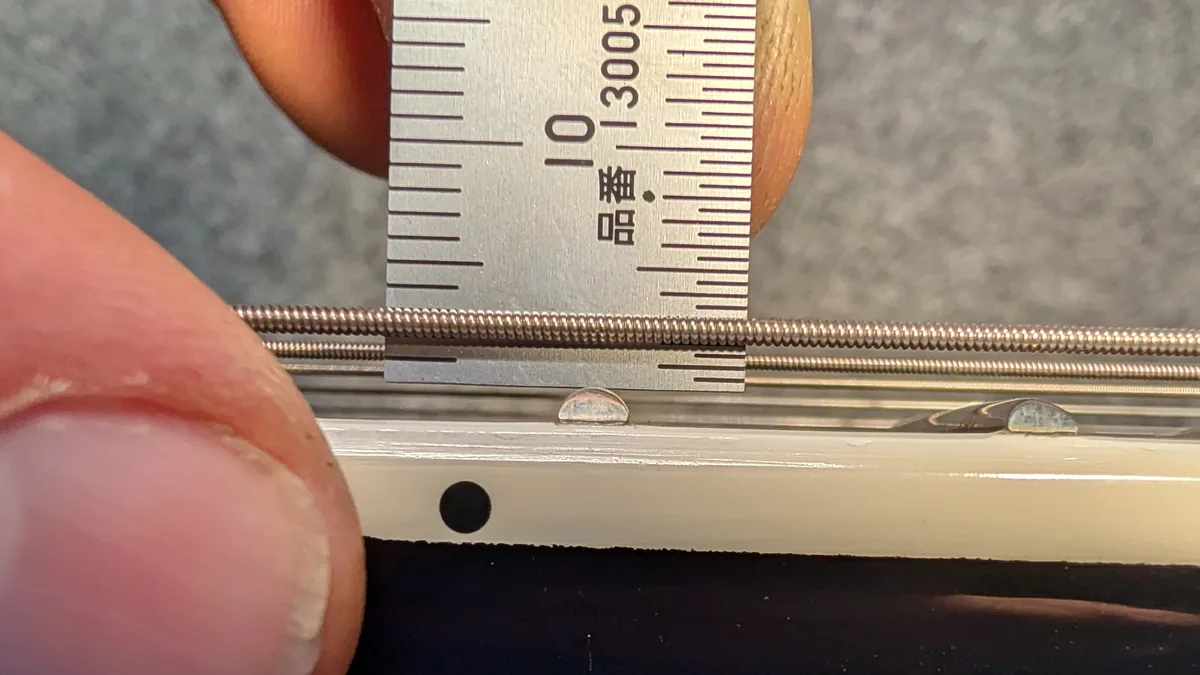
I set relief to the tolerance appropriate for your string gauge and playing style — typically 0.15mm to 0.25mm at the 8th fret with the capo at 1 and a finger at the last fret. A fingerstyle player gets the low end of that. A heavy strummer gets the high end.
Action at the saddle, radius-matched
I set string heights at the 12th fret individually, following the actual fretboard radius of your specific guitar. Not the spec. The guitar.
Strobe intonation
Each string is compensated at the saddle to within ±0.01 cents at the 12th fret harmonic. If you play in an open tuning or alternate tuning, I inonate for that.
Fretboard clean and condition
Every setup ends with a Clarity Wash decontamination pass on the body and neck, and a Resonance Balm conditioning treatment on the raw fingerboard. An undehydrated fretboard moves after a setup. I won't hand a guitar back dry.
The whole process, done properly, takes longer than most people expect. I never rush it. Wood needs time to settle between adjustments. I'll typically leave a guitar under tension overnight after the truss rod before finalising the action, because a cold neck tells me a different story than a warm one fresh off the workbench.
This unhurried sequence is why The Complete Setup (£95) operates on a dedicated 48-hour bench turnaround.
If It's Not Right When You Get It Back, I'll Come Back
This is the part I want to say plainly, because I'm not sure it's said plainly enough in this trade.
When I return your guitar, I'll walk you through what I've done. But explaining a setup on your doorstep for three minutes is not the same as playing it in your living room for a week, the way you actually play. You might find that the action feels slightly high in open chord position and you'd prefer it a hair lower. You might find the neck relief feels a little stiff under your particular right-hand attack. These are not complaints — they're information.
If you get in touch and tell me it's not quite right, I'll collect it again at no additional cost and make the adjustment. That's not a favour. It's part of the job. A setup has to work for the person playing the guitar. If it doesn't, it hasn't been finished.
I won't charge you extra to dial it in.
Booking a Setup in Dundee
Complete Guitar setups are £95 via The Complete Setup (£95), collected and returned free of charge across Zone 1 (Dundee, Broughty Ferry, Monifieth). If you're in Carnoustie or Longforgan there's a flat £10 travel feefor Zone 2 collection. If you're further afield in Angus, Perthshire, or Fife, we can arrange a drop-off and collection by appointment outside the workshop.
I work full-time, so all collections and returns happen during evenings and weekends— you won't need to take time off or reorganise your day.
Get in touch via david@thecompleteguitar.com or the booking page and tell me a bit about the guitar and how you play it. That's where a setup actually starts — before I've even picked up a feeler gauge.
What to Tell Me When You Book
- • Guitar make, model, and approximate age
- • String gauge and brand currently fitted
- • Tuning you primarily play in
- • Style of playing (pick attack weight, fingerstyle, hybrid)
- • Any specific buzzes, dead notes, or intonation complaints you've noticed
- • Whether you'd like new strings as part of the setup (£35 restring included in a bundle — I'll bring your chosen strings)
The more I know before collection, the less time the guitar spends off your wall and the more precisely I can calibrate it for you specifically.
Guitar Setup & Calibration FAQ
Clear answers on Dundee workshop setups, tolerance calibration, and our return guarantee.
Why is every guitar setup different?
Factory guitars are engineered to suit the average player, with tolerances deliberately wide enough to accommodate a broad range of styles and string gauges. No two instruments settle identically after shipping and storage, and every player wants something different — different action height, pickup height, tuning, and string gauge. A proper setup starts from scratch with feeler gauge measurements of the actual guitar, not the spec sheet.
What if I'm not happy with the setup when I get my guitar back?
If you play your guitar at home and find it's not quite right — action a hair too high, neck relief not matching your playing style — get in touch and David will collect it again at no additional cost and make the adjustment. A setup has to work for the player. If it doesn't, it hasn't been finished.
Does pickup height get adjusted during a guitar setup in Dundee?
Yes. Pickup height is part of every electric guitar setup at The Complete Guitar. It affects magnetic string pull, harmonic envelope, mid-range bite, and sustain compression — and every player's preference is different. David asks about pickup height preference before collection, and sets it precisely to the player's specification.
How much does a guitar setup cost in Dundee?
The Complete Setup at The Complete Guitar is £95, all-inclusive. It covers full 5-stage calibration: diagnostic audit, neck relief, action and radius matching, strobe intonation, and fretboard clean and condition with Clarity Wash and Resonance Balm. Free doorstep collection and return across Zone 1 (Dundee, Broughty Ferry, Monifieth). A £10 flat travel fee applies for Zone 2 (Carnoustie and Longforgan).
About the Maker & Workshop
Written and formulated by David Aitken, Master Luthier & Founder. Every care formula and calibration protocol is developed through hands-on bench experience at The Complete Guitar workshop in Douglas, Dundee (DD4 8NN), dedicated to making every instrument play 1% better every day.
Dundee Workshop & Concierge Calibration
Ready for a setup calibrated to your playing style?
Book The Complete Setup (£95) with complimentary doorstep collection and return across Zone 1 (Dundee, Broughty Ferry, Monifieth) — backed by my personal adjustment guarantee.
Dundee Workbench Calibration
Need hands-on bench calibration? Book The Complete Restring (£35), The Complete Setup (£95), The Complete Fret Service (£115), or The Complete Nut Service (£50) with complimentary doorstep collection and return across Dundee, Broughty Ferry, and Monifieth.