A Brand-New Guitar Is a Great Start. It Just Isn't Set Up for You Yet
By David Aitken · The Complete Guitar · Douglas, Dundee · DD4 8NN
If you are unwrapping a guitar this Christmas, or buying one for someone else, here is the good news first. A new guitar is a perfectly good instrument. If it feels stiff, buzzes, or hurts your fingertips, that almost never means you picked a bad one, and it doesn't mean you are bad at playing. It usually means the guitar hasn't been set up for you yet.
Do new guitars need a setup? Often, yes. A new guitar is usually a good instrument, but it is rarely adjusted to suit the person playing it. Factory settings tend to leave the strings a little high, which can make it stiff, buzzy or hard on the fingertips. A setup adjusts neck relief, string height, and intonation to suit you, and it is usually all that's needed.
I'll be straight with you: I've been working as a luthier officially for less than a year. What I can tell you is what I check on every guitar that comes onto my bench, and why those checks matter. None of it is secret. Plenty of it you can check yourself in five minutes.
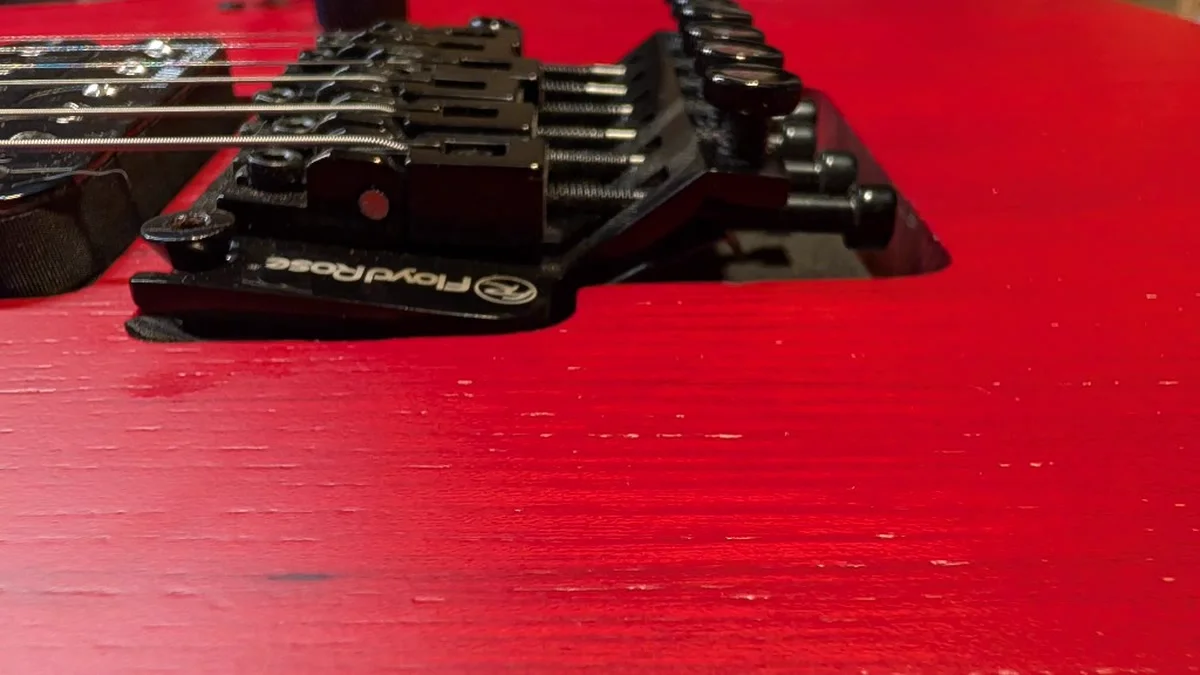
Danyelle asked me to look at her Gear4Music LA Select Series with a Floyd Rose tremolo. The trem had been pulled so far back that the strings were hitting the adjustment screws on the front face of the bridge. Once I'd corrected that and set the guitar up properly, she was very happy.
Why New Guitars Often Play Stiff
A guitar has a long trip before it reaches you. It is built, packed, shipped, stored, and sold, and wood reacts to temperature and humidity along the way. Then it arrives in a warm, dry, centrally heated living room.
As far as I understand it, factories also build in a margin. Setting the nut slots and saddle slightly high gives room for adjustment later. It protects the guitar against fret buzz if the neck moves in transit, and it keeps the guitar rugged. On top of that, production runs at pace with real tolerances, so no two guitars finish exactly alike. I can't speak for any particular factory, but it fits what I see: guitars that are playable but a bit high and stiff.
That margin suits the factory. It doesn't suit a beginner whose fingers are still building strength.
The fix is to make some adjustments.
What Is Worth Checking
A setup follows an order: neck relief, then nut, then action at the saddle, then pickups, then intonation. Here are the things I look at first, and what you can spot at home.
First-fret clearance
If the first few frets feel hard to press, the nut slots are the first place I look. Fret the low E string at the third fret, then look at the gap between the string and the first fret wire. You want a small gap, just enough that the string clears the fret. A big gap means you are pushing the string much further than you should, and it can pull open chords sharp.
A steel rule or feeler gauge will show it clearly. As a rough guide, a low gap of a few tenths of a millimetre is typical. Treat that as a starting point rather than a rule, because it varies with string gauge and playing style.
If the slots are too high, a hand-carved bone nut (£60) is one way to fix it. Recutting the slots is another, depending on the guitar.
Neck relief
A neck is never perfectly flat. It needs a very slight forward curve, called relief, so the strings can vibrate without hitting the frets. Too much relief makes the action high and stiff. Too little makes it buzz.
I check this at about the 8th fret with a 0.25mm feeler gauge and a straightedge, then adjust the truss rod in small turns of the hex key. Truss rods are easy to overturn, so small and patient is the rule.
Action at the 12th fret
Action is the string height over the frets. I measure it at the 12th fret with a steel rule. Lower action feels easier on the fingers, but go too low and the strings buzz. The right number depends on the player. A fingerstyle player and a heavy strummer won't want the same figure.
On an acoustic with a plastic saddle, a hand-carved bone saddle (£60) is an option if you want to improve sustain as well as feel.
Dry fretboards and sharp fret ends
Run your palm down the edge of the neck. If the fret ends catch, the wood has probably dried out and shrunk slightly across its width while the metal frets stayed put. Dry winter air makes this worse.
Often the first step is to clean and rehydrate unfinished fingerboards like rosewood, pau ferro or Indian laurel, rather than reaching for a file. I use Clarity Wash (£9.99) to clean and Resonance Balm (£9.99) to condition. If the ends still catch after the wood has settled, they may need dressing on the bench. I cover the seasonal side in my fret sprout guide.
Intonation
If open chords sound right but the guitar drifts out of tune higher up the neck, intonation is probably off. I set it per string at the saddle using LuthierScan, the tuner app I built, checking the 12th fret harmonic against the open string. A guitar that is in tune with itself is far easier to learn on. You can also check target relief, action, and saddle compensation specs in our interactive Guitar & Bass Setup Spec Calculator.
Precision Tuner & Setup Calculators for Android
Check 12th-fret harmonic against fretted pitch and see how far to move the saddle.
Is a New Guitar Worth Setting Up?
Yes, and it is arguably worth more on a budget guitar. Entry-level guitars are often well made for the money. What a setup adds is the careful hand adjustment that isn't built into the price.
A properly set-up starter guitar is simply easier and nicer to play. For a beginner, that can be the difference between picking it up every day and giving up after a fortnight.
I won't charge you if I can't find the cause of a fault. And if you have played the guitar for a week and want the action a touch higher or lower, get in touch and I'll collect it again at no extra cost to adjust it. That's how I describe it in my guide on why every guitar setup is personal.
Buying a Guitar as a Gift
If you are buying for someone else:
- Decide whether you will book a setup yourself or leave it to them. A set-up guitar is a better gift, but string gauge and action are personal. Some people prefer to wait until they know how they play.
- Keep the receipt and the packaging until you know it's right.
- Add care products. A Complete Care Kit (£18.99) makes a useful stocking filler, and my gift guide covers more ideas.
- Tell me about the player. Beginner, age, style and string gauge all change how I'd set it up.
What This Teaches Us
- A stiff new guitar is usually a setup issue, not a bad guitar. Factories seem to leave a safe margin, so many guitars arrive a little high.
- Check the first fret before blaming your fingers. Fret at the third fret and look at the gap over the first.
- Dry air affects fretboards. If the fret ends catch, hydrate before filing.
- The order matters. Relief, nut, action, pickups, then intonation. See my setup order guide.
- A set-up guitar is easier to learn on. That matters most for beginners.
Questions People Ask
Do new guitars need a setup?
Often, yes. New guitars are usually good instruments, but they are rarely adjusted to suit the player. A setup fine-tunes the neck, string height and intonation for you.
Why is my new guitar hard to play?
Most often the strings sit a little high, at the nut, the saddle, or both. That makes chords harder to press and can pull notes sharp. It is usually a setup issue, not a faulty guitar and not a lack of skill.
How much does a guitar setup cost in Dundee?
The Complete Setup is £95. A restring is £35. Collection and return are free across Dundee, Broughty Ferry and Monifieth, and Carnoustie and Longforgan have a £10 flat travel fee.
Should I set up a guitar I'm giving as a gift?
It can help, but string gauge and action are personal. If you're unsure, a setup in the new year, once the player has found their feel, works well too.
Booking a Setup in Dundee
- The Complete Setup (£95): relief, radius-matched action, pickup balance, intonation, and a fretboard clean and condition.
- The Complete Restring (£35): botanical fretboard clean, hydration, fret-end check and precision tuning check.
I work full-time, so servicing happens on evenings and weekends, by booking. I can't promise a fixed date, so get in touch early if you have a Christmas gift in mind.
- Zone 1 (free doorstep collection and return): Dundee (DD1–DD4), Broughty Ferry (DD5) and Monifieth (DD5 4).
- Zone 2 (£10 flat travel fee): Carnoustie (DD7) and Longforgan (DD2 5).
- Zone 3 (by prior appointment): wider Angus, Perthshire, Fife and beyond. Handover and collection are arranged outside the workshop at 33E Ballindean Road, Dundee, DD4 8NN.
Tell me about the guitar and how you play on the contact page, or book through the setup page.