How to Tell if Your Guitar Needs a Fret Level (Or Just a Setup)
By David Aitken · The Complete Guitar · Dundee, Scotland
Few things kill the joy of playing faster than fret buzz or notes that choke out mid-bend. When your guitar starts buzzing or fighting your fingers, the immediate fear is usually that the instrument is warped or requires hundreds of pounds of major workshop surgery.
On my workbench in Dundee, I look at guitars every single week where the owner believes they need a major refret or that their neck is permanently ruined. Nine times out of ten, one of two things is actually happening:
The neck relief has shifted due to seasonal humidity, the bridge saddles have settled, or the nut slots are dragging. This is easily solved at home in thirty minutes with a basic hex key.
One or two frets have lifted slightly from their slots, or years of playing have worn deep divots into the crowns. This requires The Complete Fret Service (£115) — not a full refret.
This diagnostic guide breaks down the physics of fret wear, gives you three practical home bench tests to isolate high or uneven frets, and explains how to tell whether a simple truss rod tweak will solve your problem or if it's time to level and crown.
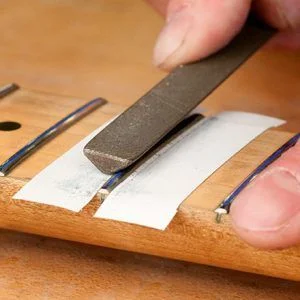
The Root Cause: Why Frets Go Out of Level
1. Mechanical String Wear (Divots & Flat Tops)
Every time you press a hardened steel or nickel guitar string against a softer nickel-silver fret crown, microscopic amounts of metal wear away. Over months and years, this creates “Cowboy Chord” divots on frets 1–3 and flattened crowns on frets 12–15. When you fret a note in a divot, the string sits lower than normal and buzzes against the unworn, taller fret immediately ahead of it.
2. Wood Movement & Seasonal Fret “Sprout” or Lift
Wood is a hygroscopic material that continuously expands and contracts with changes in ambient humidity. In Scotland and across the UK, winter heating dries indoor air down to 25–30% relative humidity, causing the fingerboard timber to shrink. When the wood shrinks, fret tangs can unseat slightly (lifting as little as 0.05 mm), causing severe buzzing on the fret behind it.
3. Factory Inconsistency
Mass-produced guitars leave the factory quickly. Factory technicians level frets under tension approximations, but as the neck timber settles into its final playing tension over the first 6–12 months, individual frets often settle at slightly differing heights.
3 Bench Tests: Setup Issue vs. Fret Level Issue
The Chromatic Walk (Single-Note Isolation Test)
Tune your guitar to concert pitch using a strobe tuner (like LuthierScan Pro). Play every single note chromatically up the fretboard on one string, from fret 1 to 21/24:
- Buzz occurs across an entire zone (frets 1–5): Diagnosis: Neck relief issue. Loosen the truss rod a quarter turn anti-clockwise.
- Buzz occurs in the upper registers (frets 12–21) across all strings: Diagnosis: Bridge action too low. Raise saddles by 0.25–0.5 mm.
- Fret 9 clear, Fret 10 dead/buzzing, Fret 11 clear: Diagnosis: High fret at #11 physically blocking vibration. Requires spot-level or full fret dress.
The Bending “Choke” Test
Fret the high-E string at the 12th fret and bend the note up a full step. Repeat at frets 14, 15, and 17. If the note abruptly dies out or hits a metallic “thud”, the forward fret is tall and blocking the bent string's travel across the fingerboard radius.
A precision fret level and compound crown eliminates this high spot without forcing you to raise your string action to uncomfortable heights.
The Fret Rocker Test (Objective Proof)
Place a 3-fret precision straightedge across frets 1, 2, and 3. Gently attempt to rock the tool like a see-saw. If the tool sits perfectly flat, the center fret is level. If it rocks with a distinct metallic “click”, the center fret is high. Walk the tool all the way up the neck across all 6 string paths.
Fret Leveling vs. Complete Refret: What's the Difference?
| Dimension | Fret Level, Crown & Polish (£115) | Complete Refret (£250–£350) |
|---|---|---|
| What Happens | Existing frets trued with precision beam, diamond recrowned, and mirror polished. | All old frets pulled from board; brand new wire installed and radiused. |
| When Needed | 95% of playing issues (divots, high frets, factory inconsistencies). | Severe fret rot or fret height worn below 0.6 mm. |
| Preservation | 100% original vintage fretwire & binding preserved. | Original wire removed; risk of fingerboard chipping. |
| Bench Turnaround | ⚡ 48 Hours | ⏱️ 1–2 Weeks |
| Typical Cost | £115 (Includes Full Setup) | £250.00+ |
The 4-Stage Luthier Fret Dressing Protocol
At our Dundee workbench, fret dressing follows a strict 4-stage craft protocol:
- Neck Trueing & Seating: Neck trued dead-straight under zero string tension with notched straightedge; loose frets wicked with thin adhesive.
- Precision Beam Leveling: Precision steel beam loaded with graduated abrasives levels crowns along string paths.
- Diamond Apex Crowning: Concave diamond crowning files restore a centered apex for spot-on intonation.
- 8000-Grit Mirror Polish & Hydration: 6 micro-mesh stages followed by Clarity Wash cleanse, Resonance Balm hydration, and full strobe setup.
What Can You Do at Home Right Now?
Before booking a bench session, follow this step-by-step triage sequence:
- 1. Hydrate the Fingerboard: Clean with Clarity Wash and nourish with Resonance Balm. Dehydrated wood contracts and unseats frets. Before trueing frets, the fingerboard must be thoroughly degreased and conditioned. Never saturate unsealed wood with harsh citrus mineral oils; explore our recommended lemon oil alternatives for guitars that nourish tonewood without softening fret slots.
- 2. Follow the T.R.A.I.N. Sequence: Never touch bridge saddles until neck relief is verified. Review The Correct Guitar Setup Order Guide.
- 3. Run the 3 Tests Above: Use a flat straightedge to confirm if buzz is isolated to a single fret.
About the Maker & Workshop
Written and formulated by David Aitken. Every care formula and calibration protocol is developed through hands-on bench experience at The Complete Guitar workshop in Dundee, Scotland, dedicated to making every instrument play 1% better every day.
Dundee Artisan Workshop · 48h Turnaround · Free Local Collection
Need a Precision Fret Level & Polish?
If your diagnostic confirms high frets, divots, or choking bends, our private Dundee bench provides complete fret trueing, diamond recrowning, 8000-grit mirror polish, and full calibration for £115 all-inclusive. If your frets show localized dips or dead spots, schedule a comprehensive bench diagnosis with The Complete Guitar in Dundee.
Dundee Workbench Calibration
Need hands-on bench calibration? Book The Complete Restring (£35), The Complete Setup (£95), The Complete Fret Service (£115), or The Complete Nut Service (£50) with complimentary doorstep collection and return across Dundee, Broughty Ferry, and Monifieth.